
The Portuguese Synagogue of Amsterdam: the Esnoga and its community
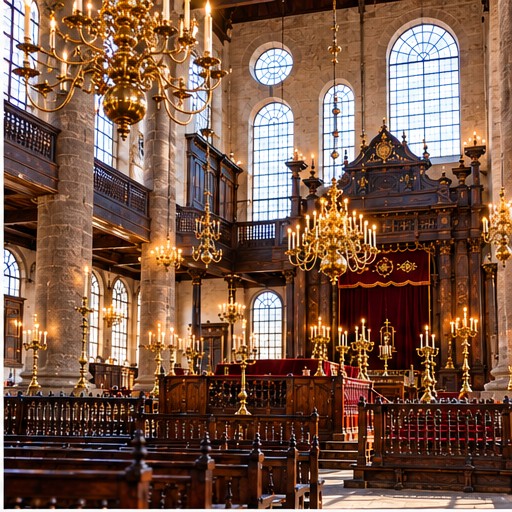
The seventeenth-century Portuguese Synagogue in Amsterdam, the Sephardic families who built it and the living community around it.
A monument that remains alive
The Portuguese Synagogue in Amsterdam, widely known as the Esnoga, is one of Europe’s most remarkable Jewish religious buildings. It opened in 1675 and still functions as a place of worship. Its austere but grand interior, illuminated by hundreds of candles rather than permanent electric lighting, gives visitors a sense of entering a different century. The building is not simply a museum artifact: it belongs to a living Sephardic congregation whose history is deeply intertwined with Amsterdam’s development as a trading and intellectual city.
Refugees from the Iberian world
The community’s roots lie in the persecution of Jews in Spain and Portugal, including people whose families had been forced into conversion. Many Jews moved through Antwerp and other commercial centers before settling in the Dutch Republic, where comparatively greater freedom allowed religious life to be re-established. Several Sephardic congregations merged in 1639 into the community known as Talmud Torah. The synagogue’s construction later expressed security, confidence and the wish for an enduring institutional home.
Architecture and candlelight
The main prayer hall has high windows, large timber furnishings and a striking holy ark facing Jerusalem. The light of candles, the polished floors and the surrounding galleries contribute to its famous atmosphere. Visitors often notice how little the building’s basic ritual setting has changed since the seventeenth century. This continuity is unusual in European Jewish history, where synagogues were frequently destroyed, redesigned, moved or closed during periods of persecution and upheaval.
Learning and commerce
Amsterdam’s Portuguese Jews contributed to trade, publishing, medicine, literature and philosophy. Hebrew and Iberian languages circulated among families, scholars and merchants. The community also maintained a major library and archive tradition. The synagogue thus belongs to a story of religion alongside secular learning, international exchange and urban economics. That mixture makes the Esnoga especially interesting for anyone studying Jewish life outside the Middle East and the transformation of early-modern European cities.
Survival and remembrance
Amsterdam’s Jewish communities suffered catastrophic persecution during the Nazi occupation of the Netherlands. The Esnoga survived as a building, but a historic structure cannot stand in for the lives that were destroyed. Understanding the synagogue today therefore involves both the achievements of the seventeenth-century Sephardic world and the memory of twentieth-century losses. The Jewish Cultural Quarter provides exhibitions and interpretation that help visitors connect these different layers.
Planning a visit responsibly
The synagogue stands at Mr. Visserplein 3 in central Amsterdam and can usually be visited Sunday through Friday, while remaining closed to tourism on Saturday. Opening conditions and religious services can affect access, so the official Jewish Cultural Quarter schedule should be checked. The strongest visit combines architecture with community history. The Esnoga is both a beautiful building and evidence of how refugees helped create a lasting Jewish institution in the Dutch capital.