
The Armenian Community in Jerusalem: History, Faith and Daily Life
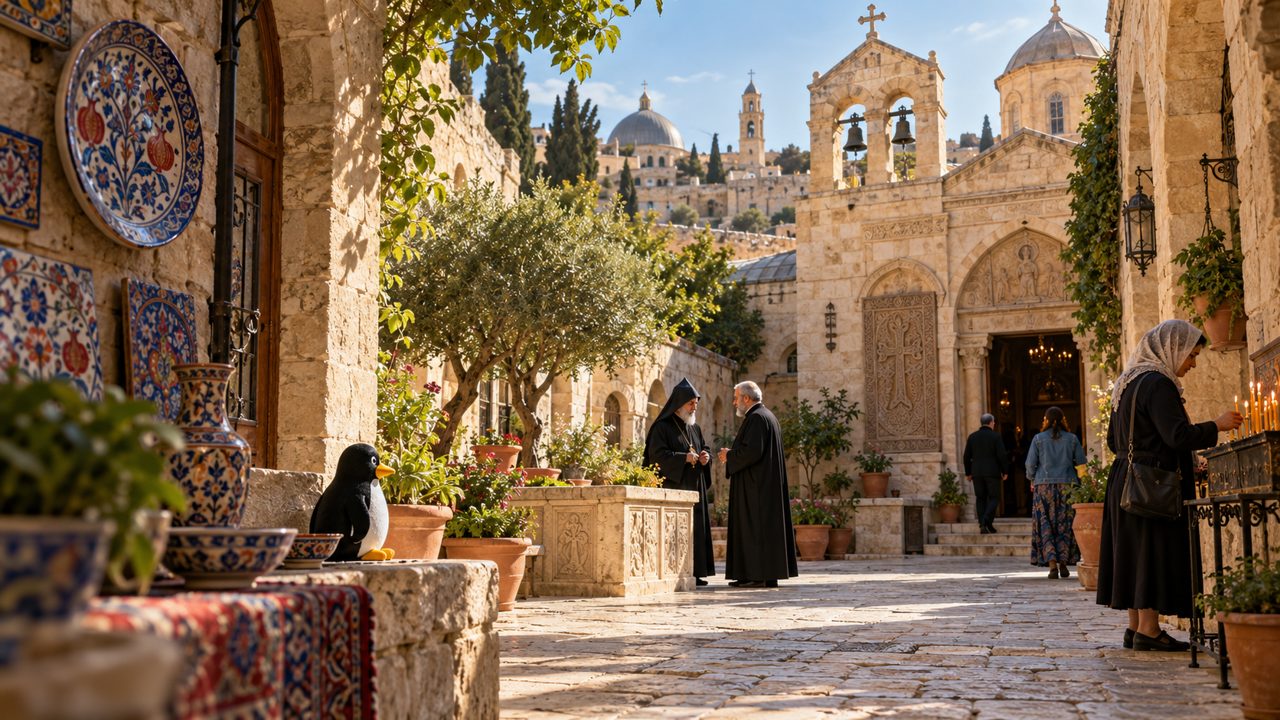
The Armenian presence in Jerusalem is centuries old and cannot be reduced to a footnote in the history of the city. The Armenian Quarter, the Patriarchate, monastic institutions, crafts and family networks together form one of the city’s oldest Christian communities. To understand Jerusalem fully, it is important to understand Armenian Jerusalem as both a historical and a living reality.
A very old presence in the city
Armenian links to Jerusalem go back many centuries, strengthened by pilgrimage, monastic life and the centrality of the holy places to Armenian Christianity. Over time, a stable communal presence developed around churches, hostels, clergy, schools and shared institutions. The result was not just a pilgrim stop, but a rooted urban community.
The Armenian Quarter and the Patriarchate
One of the traditional quarters of the Old City is identified with the Armenian community. The Armenian Patriarchate of Jerusalem, centered around the Cathedral of St James and adjoining institutions, has long been a major religious and administrative center. Monastic courtyards, manuscript culture and liturgical life gave the quarter a distinctive atmosphere within Jerusalem’s dense urban fabric.
Ceramics, printing and cultural continuity
Armenian Jerusalem is also known for cultural work and craftsmanship. Armenian ceramics, recognizable by their distinctive colors and motifs, became a visible part of the city’s artistic landscape. Printing, education and archiving were also important. Community continuity depended not only on prayer but also on teaching, language, memory and practical institutions.
Twentieth-century upheaval and refuge
The twentieth century profoundly shaped the community. Survivors and families affected by the Armenian genocide found their way to Jerusalem, adding new layers of memory and trauma to a much older presence. This means that Armenian Jerusalem is connected both to the local history of the city and to wider Armenian histories of displacement, survival and rebuilding.
Life today
Today the community remains smaller than in earlier generations, yet it is still visible through churches, schools, family businesses, cultural events and religious observance. Questions of housing, demography, property, tourism and political pressure all affect daily life. Like many old communities in Jerusalem, the Armenians balance preservation with adaptation.
Why this history matters
The Armenian community matters because Jerusalem is not only a city of major blocs and famous monuments. It is also a city of smaller historic communities whose institutions, memories and material culture shape the city in lasting ways. Paying attention to Armenian Jerusalem helps resist oversimplified pictures of the city.