
Eliezer Ben-Yehuda, the cat and the revival of Hebrew
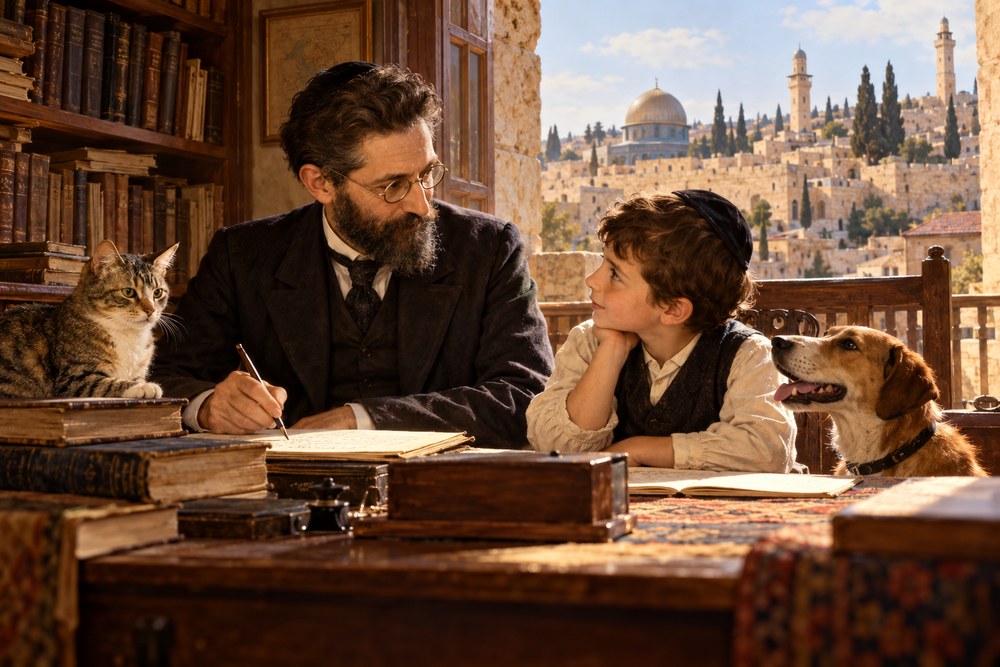
Why a dog and a cat featured in the extraordinary family experiment to make Hebrew a living mother tongue in Jerusalem. The following article distinguishes documentary facts, religious beliefs, historical memories and modern public practices.
How a cat entered the story
In the Jerusalem household of Eliezer and Devora Ben-Yehuda, a cat and a dog were not merely pets. According to an account by the linguist Lewis Glinert, one animal was male and the other female, giving their young son Itamar Ben-Avi opportunities to hear adjectives and verbs in masculine and feminine Hebrew forms. This delightful domestic detail opens a much larger story: Ben-Yehuda wanted his son to grow up with Hebrew not as a language of books but as the language of everyday life.
A language with a long past and a new challenge
When Ben-Yehuda came to Ottoman Palestine in 1881, Hebrew had never completely vanished. It remained central to prayer, scholarship, correspondence and writing. Yet it was not widely used as the continuous mother tongue of households. Ben-Yehuda argued that a modern Jewish national society needed Hebrew in kitchens, classrooms, workshops, streets and homes. The revival therefore meant changing habits, not merely inventing words.
The child, the animals and the first words
In Glinert’s retelling, a wet nurse agreed to speak Hebrew, while a dog and a cat helped create an environment rich in speech. The family reportedly worried when the child was slow to speak. A famous version describes his cry of “Abba” as a milestone after an emotional moment. The details are best understood as a story transmitted through memory; they should not be treated as a literal transcript of an event.
Newspapers, schools and the dictionary
The family alone could not revive a language. Ben-Yehuda wrote and edited Hebrew newspapers, advocated Hebrew-language education, helped create the Hebrew Language Council and invested much of his life in a historical dictionary. Teachers, writers, printers, schoolchildren and many other families shared the work. New vocabulary was needed for railways, medicine, modern professions and municipal life, but Hebrew could also draw upon biblical, rabbinic and medieval layers.
The wider and sometimes difficult history
The familiar label “father of modern Hebrew” is useful but incomplete. Other people used, taught and developed Hebrew before and alongside Ben-Yehuda. Language revival also involved tensions with Yiddish, Ladino, Arabic and other Jewish languages already spoken by communities. These languages possessed their own literatures and histories. Recognizing that complexity does not diminish the success of Hebrew; it makes the achievement more historically honest.
From the cat to an entire society
Ben-Yehuda died in Jerusalem in 1922. Today Hebrew is used in everything from hospitals and high technology to poetry, advertising, television and family conversations. The cat and dog story captures the transformation in a small image: a language becomes truly alive when a child can name an animal, laugh at a parent, ask for breakfast and tell the stories of ordinary life.