
Bnei Brak: life in Israel’s ultra-Orthodox city
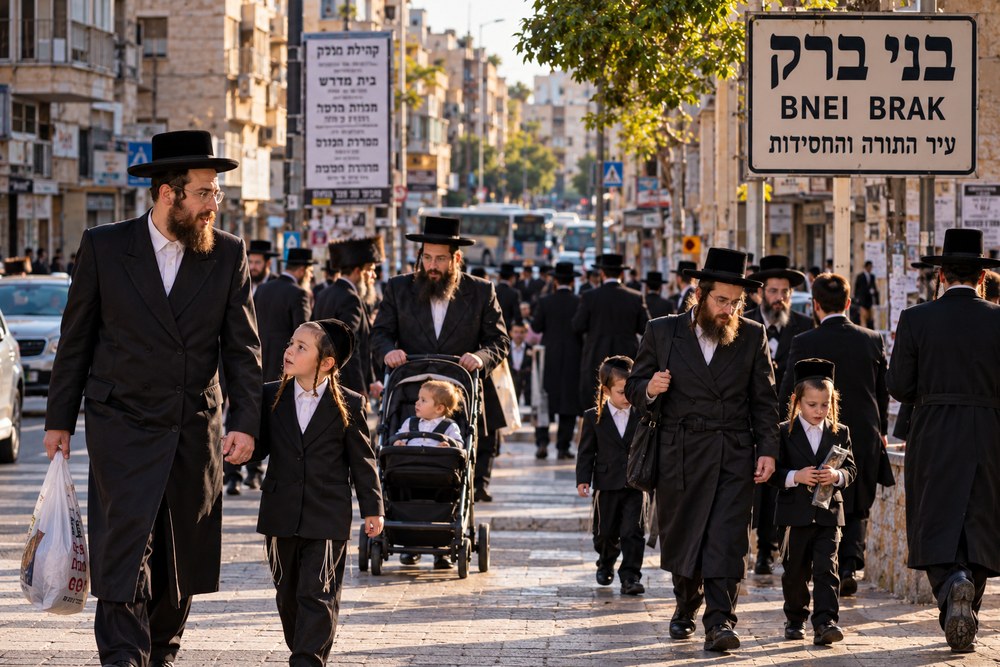
The Haredi community of Bnei Brak, its religious institutions, family life, clothing, crowded streets and demographic realities.
A different urban atmosphere
Bnei Brak, east of Tel Aviv, is one of Israel’s most visible centers of Haredi, or ultra-Orthodox, Jewish life. Visitors notice yeshivot, modest clothing shops, kosher food businesses, synagogues and large families on streets where religious rhythms shape much of the day. Black hats, long coats, head coverings and children in school uniforms are common sights. However, the statement that exactly 99 percent of people on the street dress religiously is not a verified statistic. What can be said is that the city has a strongly Haredi identity and a distinctive public culture.
From new neighborhood to dense city
Bnei Brak was founded in the twentieth century and grew into a dense city with multiple Haredi communities. These include different Hasidic groups, Lithuanian-style yeshiva communities and Sephardi Haredim, with meaningful differences between them in custom, language and education. The city is closely linked to national rabbinic networks and religious publishing. It also contains clinics, schools, commercial streets and ordinary urban services that must function for a large population within a limited area.
Education and daily routines
Study is central to many families. Boys may attend religious schools and later yeshivot; girls attend schools within their community’s educational framework. Synagogues host prayers, study sessions and communal gatherings throughout the day. Sabbath changes the public rhythm dramatically as businesses close and pedestrian movement becomes more prominent. Visitors should treat neighborhoods as residential communities, not open-air exhibits. Respectful behavior and modest photography practices matter as much here as in any religious district.
Family size and demographics
Large families are a familiar part of Bnei Brak’s public image, but averages must be specified carefully. Israel Democracy Institute research reports that the Haredi fertility rate declined from about 7.5 children per woman in 2003–2005 to roughly 6.5 in 2021–2023. These are figures for Israel’s Haredi population, not a precise count of children in every Bnei Brak household. Residents differ by age, community, income and personal circumstances, so a demographic average should never be converted into a stereotype about individual families.
Economics, pressure and change
Bnei Brak faces the challenges of a dense and relatively young population: housing prices, limited space, transport congestion and the need for schools and public services. Employment and higher education are subjects of debate inside Haredi society. Women frequently play important economic roles, and patterns of work are changing, though they vary across sectors. Discussions about public budgets and military service also affect the city, as part of broader Israeli arguments about collective obligations and support for different educational systems.
A city that is not a separate state
Sometimes Bnei Brak is described rhetorically as a religious state within Israel. That description exaggerates: it is a municipality within the Israeli legal and administrative system. Still, its local norms can make it feel markedly different from nearby secular areas of greater Tel Aviv. The city shows that Israel is not culturally uniform. Its religious communities combine continuity with adaptation, and understanding them requires more than judging their visible clothing or counting the children in a passing stroller.