
Albert Einstein and the invitation to become president of Israel
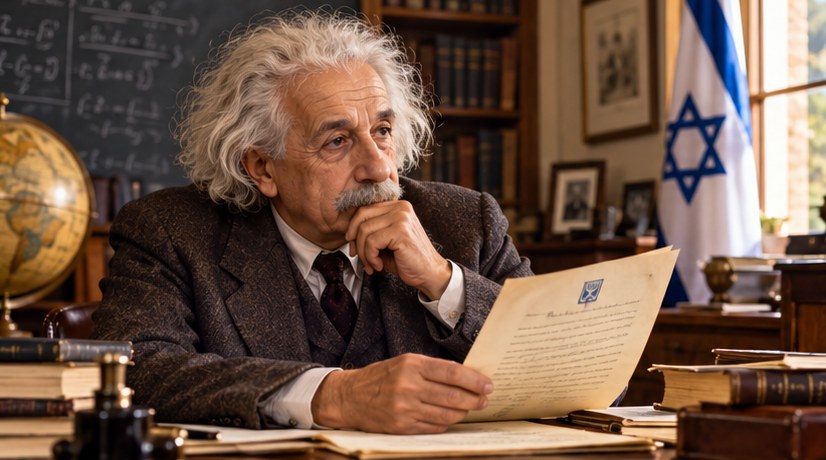
The true story of the 1952 invitation to Albert Einstein, his answer and his connections to the Hebrew University and Zionism.
The offer that surprised the world
In November 1952, after Israel’s first president Chaim Weizmann died, the Israeli government approached Albert Einstein about becoming the country’s second president. The proposal was communicated by Israel’s ambassador to the United States, Abba Eban, on behalf of Prime Minister David Ben-Gurion. The historical record is unusually clear: it was a serious inquiry, not a rumor that grew from a casual compliment. Einstein was deeply honored, but he declined the post. The story has remained famous because the scientific celebrity was asked to consider a role normally reserved for experienced politicians.
What Einstein was actually asked
The president in Israel is head of state, while the prime minister and cabinet govern day-to-day policy. Eban therefore asked whether Einstein would accept election by the Knesset to this representative office. In the embassy’s published account, Eban spoke with Einstein on 16 November and followed up in writing on 17 November 1952. This distinction matters: the government did not appoint Einstein, and he never entered an election. He was invited to say whether he would be willing to serve if elected under the constitutional procedures.
Why he refused
Einstein’s refusal was courteous and personal. He felt inadequate for a post that required dealing with people and political relationships, skills he said he had not cultivated to the same degree as scientific thought. He also knew that a symbolic office carried practical burdens: diplomacy, public representation, ceremonies and endless conversations. The refusal should not be interpreted as a rejection of Israel or Jewish national life. It was an expression of his understanding of the difference between being an intellectual authority and becoming a constitutional public official.
Jewish identity and the Hebrew University
Einstein had long been involved in Jewish causes, and his relationship with the Hebrew University of Jerusalem was particularly important. He helped promote the university as a center of knowledge and intellectual life, and later left his literary estate and rights to the institution. Yet his Jewish commitments did not mean that he agreed with every government policy. He supported cultural and educational renewal while remaining outspoken about peace, civil rights, relations between Jews and Arabs, and the dangers of nationalism without moral restraint.
The limits of a famous anecdote
Popular versions sometimes suggest that Israel simply offered Einstein the presidency and he said no because he was too busy inventing theories. That version misses both the formal process and the seriousness of his response. The invitation emerged from a specific historical moment in a young state searching for a widely respected successor to Weizmann. The response illuminated the complicated relationship between fame and democratic legitimacy, between moral prestige and the ordinary skills required for public administration.
Why the episode still matters
The Einstein story offers a useful lens on the early Israeli republic. It shows the respect that state builders gave to learning and science, but it also shows that individuals can serve a country without holding office. Einstein’s refusal did not end his link with Israel: his scientific and humanitarian legacy is visible in Jerusalem through the Hebrew University. For readers today, the episode asks a question more general than its celebrity protagonist: should exceptional achievement in one field be considered a qualification to lead in another?