
The Church of the Holy Sepulchre and the immovable ladder
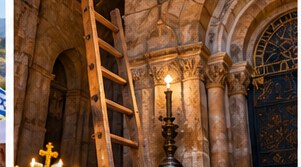
A church at the center of Christian Jerusalem
The Church of the Holy Sepulchre stands in the Christian Quarter of Jerusalem’s Old City. For many Christians, its chapels commemorate the place where Jesus was crucified, buried and raised from the dead. This conviction made the site one of Christianity’s principal pilgrimage destinations. Pilgrims from different countries and religious traditions visit the building, often joining worshippers who live in Jerusalem itself. The church is not a modern museum: daily prayers and services remain part of its life.
The earliest monumental church on the site was constructed in the fourth century under the emperor Constantine. According to Christian tradition, Helena, his mother, helped identify the holy places in Jerusalem. The structure experienced destruction, restoration and rebuilding across many centuries. The present complex preserves a layered history, including important medieval architecture and a later restored shrine around the traditional tomb.
Six communities and the Status Quo
The church is shared by several Christian communities rather than administered by one denomination. The Greek Orthodox, Roman Catholic community represented by Franciscans, and Armenian Apostolic Church have the largest historical responsibilities. Coptic Orthodox, Syriac Orthodox and Ethiopian Orthodox Christians hold other established rights. These communities have their own liturgical traditions, calendars, vestments and languages, and services can take place in different areas on the same day.
Rules commonly called the Status Quo govern access, worship schedules, use of chapels and many details of maintenance. Some arrangements took their present form during Ottoman rule in the nineteenth century, although their roots are older. Because changes to shared spaces can affect several communities, even apparently small alterations often require careful discussion. This is a reason why the building is both a powerful religious symbol and a practical lesson in coexistence.
Why the wooden ladder became famous
A small wooden ladder stands on an upper exterior ledge of the church facade. It appears in old depictions and is commonly called the “immovable ladder.” The name does not mean it is physically impossible to lift. Rather, the ladder came to represent the delicate balance of rights under the Status Quo and the reluctance to alter objects without agreement among custodians. Stories about exactly when it was first placed there differ, so a precise origin should not be asserted as certain.
The ladder attracts photographers because it is easy to miss in the imposing stone frontage. Its humble appearance contrasts with the enormous importance of the site. Visitors who notice it can connect a minor architectural detail to centuries of negotiation among religious communities. It is often used as an illustration of how tradition, ownership and practical administration become intertwined.
Visiting, worship and the living heritage
Inside the church visitors encounter the Stone of Anointing, the Rotunda with the Edicule around the traditional tomb, and stairways leading to chapels associated with Calvary. The building can be crowded during major feasts such as Easter. Catholic and Orthodox ceremonies do not always take place on the same dates, and the church follows detailed arrangements for worship.
Visitors should expect security and entry arrangements to change, dress respectfully, and avoid blocking religious services. For historical context, consult the Franciscan Custody of the Holy Land, academic studies of the complex and the Wikimedia Commons collection of photographs, including documentary views of the ladder. The church is simultaneously an archaeological, artistic and spiritual place whose history cannot be reduced to a single denomination or era.