
Israel’s air defence in 2026: Iron Dome, Arrow, Iron Beam and the drone challenge
A source-based overview of Israel’s layered missile and drone defence, verified Iran-war interception figures, the Iron Beam laser and remaining challenges in 2026.

Why Israel uses several defensive layers
Israel does not rely on a single ‘shield’. Its integrated air-defence network is organised around different threat profiles: short-range rockets and some unmanned aircraft, medium-range rockets and cruise missiles, and longer-range ballistic missiles that can travel at very high speeds. Each problem requires different detection, tracking and interception capabilities. Iron Dome primarily addresses the short-range layer; David’s Sling covers an intermediate layer; Arrow 2 and Arrow 3 specialise in ballistic threats, including high-altitude interception. Aircraft, naval units, radars, command systems and partners also contribute. These descriptions are broad and do not disclose operational deployment details.
What happened during the June 2025 Israel–Iran war
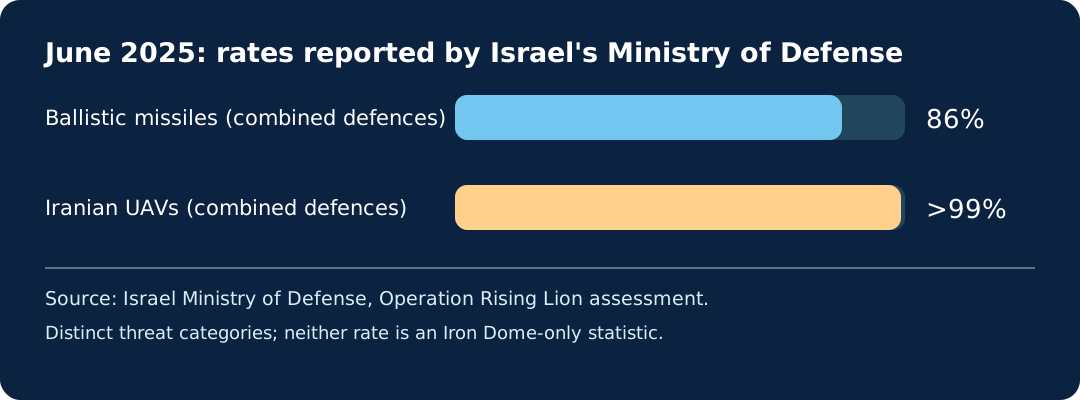
During Operation Rising Lion, the conflict from 13 to 24 June 2025, Iran fired ballistic missiles and drones toward Israel. In its official assessment, Israel’s Ministry of Defense reported that 86% of ballistic missiles launched from Iran toward Israeli territory were intercepted. It reported more than 99% of Iranian drones were intercepted. These are different denominators: the ballistic-missile figure is not Iron Dome’s standalone success rate, and the drone figure reflects the combined defensive response, including aircraft and other platforms. The ministry also said that interceptions prevented damage on a scale estimated to be seven times the actual damage sustained. That final estimate is the ministry’s assessment rather than an independently established monetary figure.
Reading the numbers carefully
A separate ministry statement dated 8 October 2026 said Iron Dome had recorded more than 10,000 operational interceptions during approximately 15 years in service. That cumulative statistic should never be presented as the number of interceptions during the June 2025 Iran war. Likewise, an IDF overview published on 7 October 2026 reported approximately 1,200 ballistic projectiles launched toward Israel from Iran since the beginning of the wider war in 2023. That longer-period total is not directly comparable to the 2025 interception percentage. Percentage claims also depend on the definition of incoming, threatening and engaged targets, which is not always identical across reports.
Iron Dome: why selective interception matters
Iron Dome became operational in 2011. Its surveillance and command functions help determine which approaching rockets appear likely to endanger populated areas or other protected locations, allowing resources to be allocated to assessed threats. The system has been upgraded over time to address a broader range of scenarios, including cruise missiles, drones and substantial simultaneous salvos. An Israeli Ministry of Defense announcement on 30 June 2026 described additional tests against rockets, cruise missiles and UAVs and integrated scenarios with the new laser layer. A high cumulative interception total does not mean every projectile is engaged or that protection is infallible.
David’s Sling and Arrow: other parts of the picture
David’s Sling fills a distinct defensive role and has undergone additional tests against missiles, aircraft, cruise missiles and unmanned aircraft. The US Missile Defense Agency and Israel announced a new David’s Sling test series in February 2026. Arrow 2 and Arrow 3 address ballistic-missile threats at higher altitudes; the two countries announced a further Arrow test in August 2026. During the Iran conflict, attributing all ballistic-missile interceptions to Iron Dome would therefore be technically misleading. It is the combination of systems, supporting sensors and command decisions that matters.
Iron Beam: the laser has moved beyond a prototype
Israel’s Ministry of Defense and Rafael handed over the first operational high-power Iron Beam laser system to the Israel Defense Forces on 28 December 2025. Earlier trials involved rockets, mortar rounds and UAVs. Subsequent integration is meant to complement, not replace, the kinetic interceptors of Iron Dome, David’s Sling and Arrow. A laser may offer a much lower marginal cost per engagement and does not consume a conventional interceptor missile for each shot. Yet electricity, maintenance, available line of sight, atmospheric conditions and engagement duration impose practical limits. Public announcements about initial delivery should not be confused with nationwide, unlimited coverage.
Why drones may become a growing challenge
Uncrewed aircraft range from inexpensive small quadcopters to larger one-way attack platforms. Their varied speeds, routes and signatures can complicate identification and create difficult cost trade-offs. Large numbers launched together can impose demands on sensors, operators and interceptor inventories even when many are defeated. Future protection depends on a balanced mix of sensing, electronic measures, aircraft, conventional interceptors and directed energy. The lesson of 2025 is that a high reported interception percentage can coexist with dangerous impacts, civilian casualties and damage; investment must therefore also include alerts, shelters, medical response and resilient infrastructure.
Protection is not a guarantee
No published interception percentage proves that an entire population was continuously safe. Some ballistic missiles penetrated Israeli defences in June 2025, causing deaths, injuries and damage. Effective civil protection includes access to shelter, rapid warning, emergency medical care and reliable public communications. Data cited here are attributed to the issuing institutions, reflect specific reporting periods and may be revised. For current safety instructions, readers should use Israel’s official Home Front Command rather than this historical overview.
Sources and reporting periods
- Israeli Ministry of Defense, 2025 interception rates
- Israeli Ministry of Defense, Iron Beam delivery 28 Dec 2025
- Israeli Ministry of Defense, Iron Dome upgrade 30 Jun 2026
- Israel MFA, 8 Oct 2026, operational interceptions over 15 years
- US Missile Defense Agency, David’s Sling 11 Feb 2026
- US Missile Defense Agency, Arrow test 6 Aug 2026
- IDF, cumulative projectile figures 7 Oct 2026