
The kibbutz movement: history, change and how many kibbutzim remain
A long article about the kibbutz movement in Israel: its socialist roots, agriculture, privatization, industry and the number of kibbutzim and residents today.
Origins of the kibbutz idea
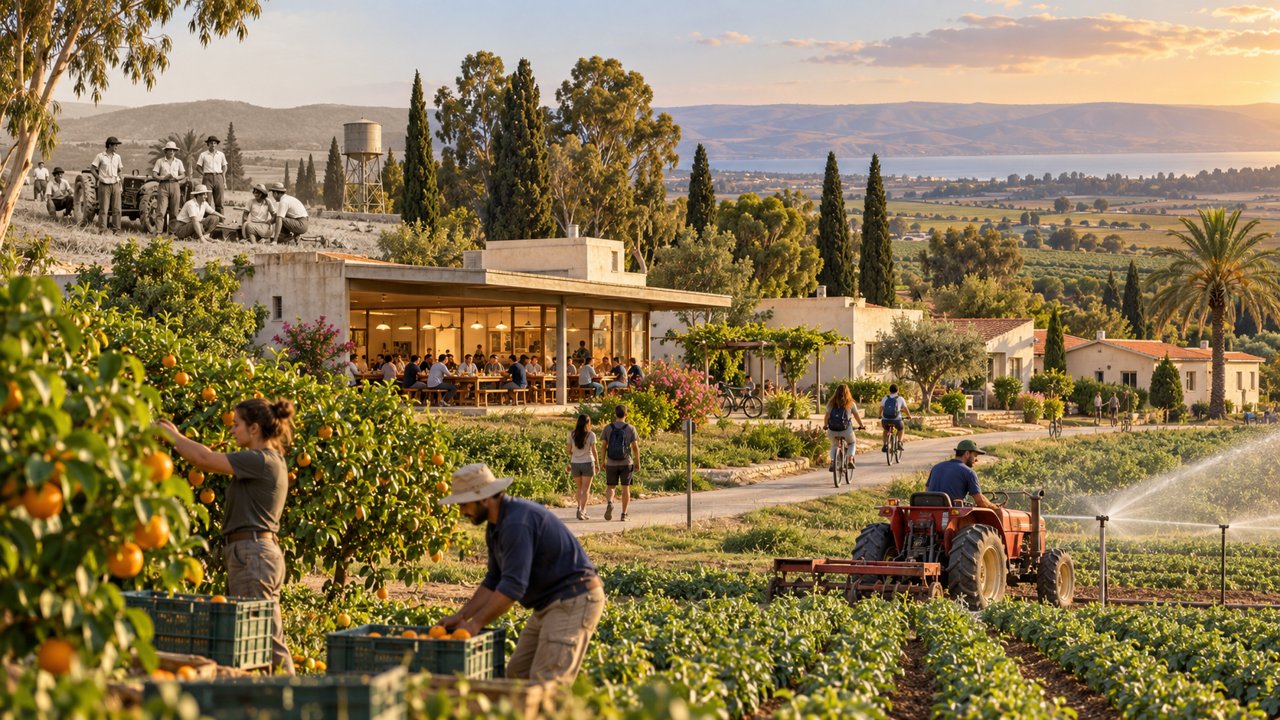
The kibbutz began as one of the boldest social experiments of the Zionist project: a cooperative rural community built around agriculture, shared labor, collective responsibility and a highly egalitarian ethos. Early kibbutzim helped shape defense, settlement geography, farming and education in pre-state Jewish society. They also created a powerful cultural mythology: the new Hebrew worker, the communal dining hall, the children’s house, the fields at dawn and the belief that a different kind of society could be built through daily practice.
From ideology to adaptation
Over time, the kibbutz world changed profoundly. Economic crises, social shifts and broader Israeli consumer culture pushed many kibbutzim away from the old all-inclusive collective model. Many introduced differential salaries, privatized parts of their internal life or expanded into industry, tourism and high-value agriculture. Yet the movement did not disappear. It adapted. In many places the kibbutz today is neither the old socialist commune nor an ordinary suburb; it is a hybrid community where collective institutions still matter even after decades of reform.
How many kibbutzim and residents remain
The exact number depends on how one defines the movement. Public material from the Kibbutz Movement speaks of about 260 kibbutzim and cooperative communities, with roughly 160,000 residents, around 60,000 of them formal kibbutz members. Academic reference works often cite a broader figure of about 270 kibbutzim with a population around 140,000. The difference reflects varying definitions and dates, but the larger point is clear: the kibbutz remains a significant, living social form rather than a museum piece.
Why the kibbutz still matters
Kibbutzim continue to matter because they sit at the intersection of history, land, food production, border regions and collective memory. They are associated with orchards, dairies and irrigation, but also with schools, memorials, cultural archives and changing debates about equality. For Israelis, they remain part of the national story. For outside readers, they offer a window onto how ideology becomes landscape—and how landscape, in turn, shapes identity.
Selected links and institutions
Note
Different institutions count kibbutzim in slightly different ways, so any figure should be read as approximate and tied to a specific date and definition.