
How Israel turns seawater into drinking water: plants, prices and the 2026 crisis
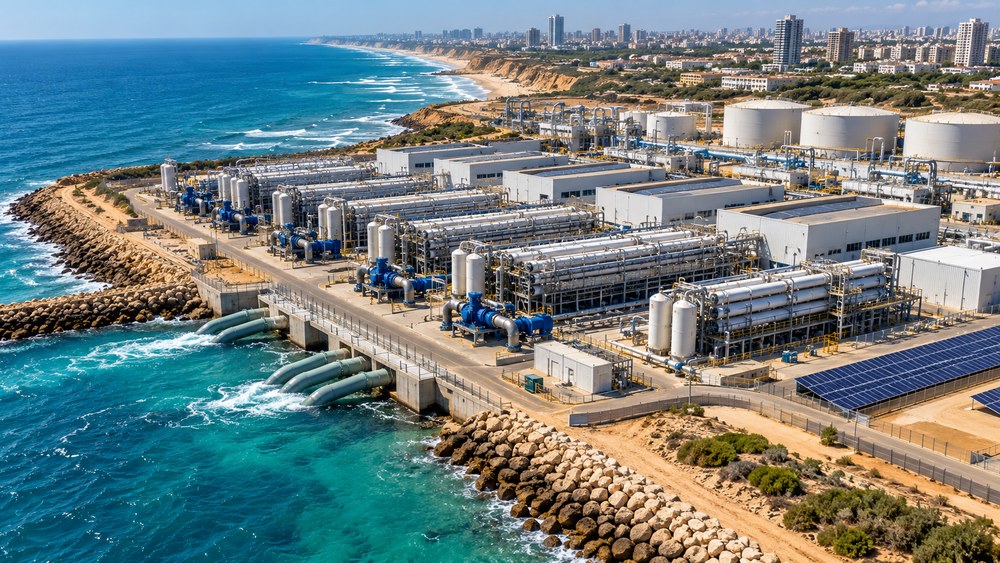
Reverse osmosis, the Sorek B expansion, typical desalination costs and the September 2026 algae disruption. The following article distinguishes documentary facts, religious beliefs, historical memories and modern public practices.
A country that learned to make water
Israel invested heavily in desalinating Mediterranean seawater because its natural freshwater resources cannot reliably meet a growing population’s needs. Modern seawater reverse osmosis has become central to the supply network. According to official and journalistic reporting in 2026, desalination can provide around 70 to 80 percent of potable water needs when facilities operate as planned.
How reverse osmosis works
A desalination plant pumps seawater ashore, filters it to remove particles and microorganisms and drives it under pressure through semipermeable membranes. Most dissolved salts remain on one side; fresh water emerges on the other. The product then receives further treatment and minerals before entering the drinking-water network. Concentrated brine returns to the sea under regulated conditions.
Large Israeli plants and Sorek B
Israel operates major plants along the Mediterranean coast, including Sorek, Hadera, Palmachim, Ashkelon and Ashdod. In January 2026 Sorek B entered full operation with a planned annual output of 200 million cubic meters. Together with other facilities, the expansion increased supply security, though treatment, pumping and maintenance demand significant energy and specialized equipment.
What a cubic meter costs
The price of desalinated water must be distinguished from the retail price on a household water bill. Reports in September 2026 described ordinary payments to operators in a range of roughly 1.5 to 2.7 Israeli shekels per cubic meter, depending on the plant and contract. During an emergency caused by algae and seawater turbidity, payments rose to about four shekels per cubic meter to help keep facilities operating.
The algae crisis and the need for backup
In late August and September 2026, unusual microalgae and turbid seawater forced five of six major plants to shut or reduce output temporarily. The Knesset State Control Committee reviewed the risks, including emergency reserves and long-term planning. Households generally kept receiving water, but agriculture and park irrigation faced restrictions. The episode demonstrated that desalination is essential yet not invulnerable.
Water reuse and long-term policy
Desalination is only one part of Israel’s water system. Treated wastewater and brackish water contribute heavily to irrigation, while natural aquifers and reservoirs remain strategic reserves. Environmental costs include energy demand, membrane replacement, marine discharge and the need for resilient infrastructure. Comparing costs therefore requires considering production, transport, backup capacity and ecological safeguards together.