
The Italian Synagogue and Museum of Italian Jewish Art in Jerusalem
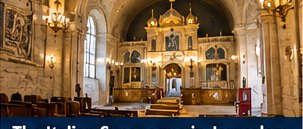
An Italian synagogue in Jerusalem
In central Jerusalem, the Museum of Italian Jewish Art preserves a rare connection between Jewish communities in Italy and modern Israel. Its best-known feature is a historic synagogue interior associated with Conegliano Veneto in northern Italy. The furnishings and ritual objects were brought to Jerusalem and reconstructed so visitors could encounter a setting shaped by centuries of Italian Jewish worship. The venue is not the same as a newly built neighborhood synagogue; it is both a sacred space and a heritage institution.
The story of Italian Jewish communities
Jews have lived on the Italian peninsula for more than two thousand years, through the Roman era, medieval cities, ghettos, emancipation and the catastrophes of fascism and the Holocaust. Regional communities developed distinctive liturgical melodies, synagogue architecture and artistic traditions. Jewish life differed considerably between Rome, Venice, Florence and smaller towns. The Jerusalem museum shows that these traditions cannot be reduced to one uniform practice, and that furniture, textiles and manuscripts reveal links between local artistry and religious law.
Art, ritual and restoration
Exhibits may include Torah ornaments, carved wooden furnishings, silverwork and textiles used on festivals and during synagogue services. Restorers must balance preservation of fragile materials with the needs of worshippers and museum visitors. A synagogue ark, the cabinet containing Torah scrolls, is especially important because it makes the direction and focus of prayer tangible. Historic benches, lamps and decorative details offer clues to how people once moved, sang and gathered in a community that is geographically far from today’s Jerusalem.
Why the museum matters
Moving a synagogue interior raises questions about heritage. Objects removed from their original town can be protected and studied, but the new setting changes their meaning. In Jerusalem, the collection acts as a meeting place for Israeli residents, Italian Jewish visitors, students and tourists. It helps explain Jewish continuity not as a simple uninterrupted line, but as a chain of reconstruction, migration and adaptation. For visitors, the appropriate distinction is between original elements, restoration and contemporary museum interpretation.
Practical and historical context
An article about the site should identify it as a museum of Italian Jewish culture rather than just another Jerusalem attraction. Opening hours, access to active worship spaces and photography rules should be checked with the institution, because they can change during holidays. The surrounding city has many synagogues with different traditions, allowing visitors to compare how Jewish communities created distinct expressions of the same religious heritage.
Sources
October 2026