
Judaism: religion, culture and history
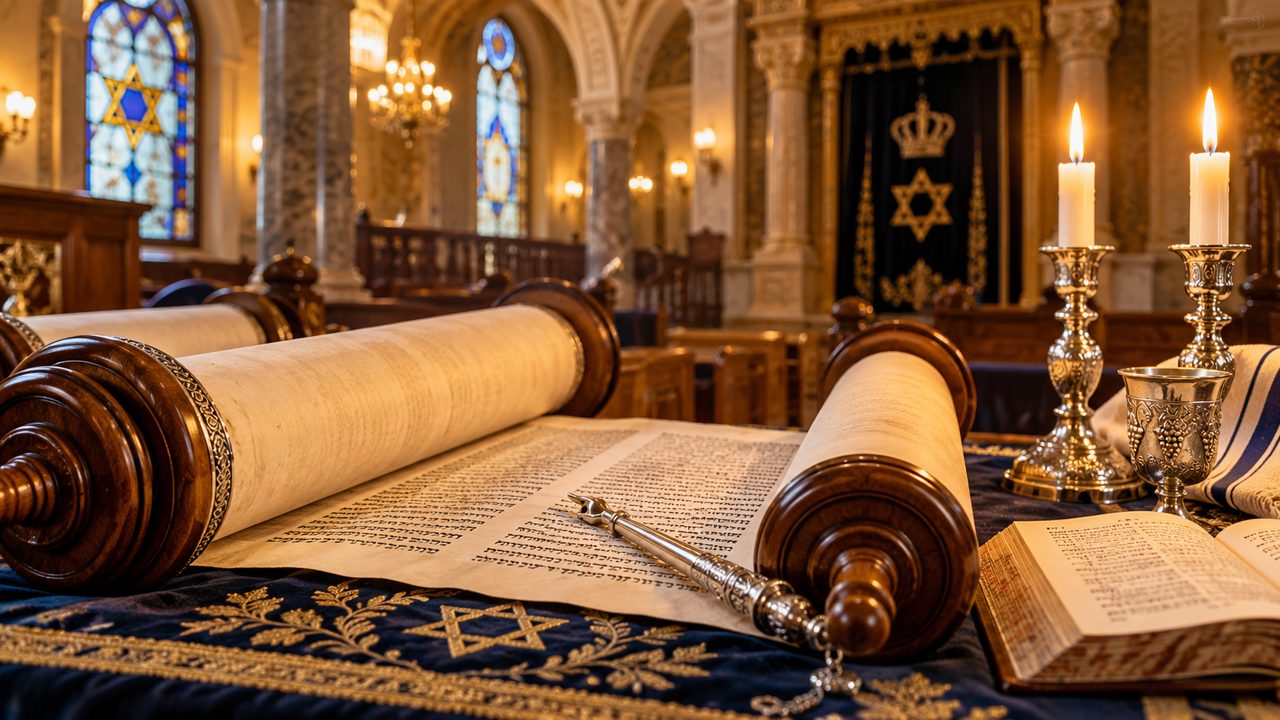
Judaism is one of the world’s oldest living religious traditions. It is at once a religion, a civilization, a long memory carried across continents, and a family of communities linked by texts, rituals, holidays and argument. For many Jews, faith and practice stand at the center; for others, Jewishness is lived through language, food, ethics, family history or solidarity with a people whose story spans the Land of Israel and the global Diaspora.
Origins and historical development
The roots of Judaism are tied to the biblical narrative of the people of Israel, to the covenantal language of the Torah and to ancient Jewish life in the Land of Israel. After the destruction of the Second Temple, Jewish life changed profoundly, but it did not disappear. Rabbinic Judaism developed around study, prayer, law and communal life, allowing Jewish continuity to survive dispersion, exile, persecution and migration.
Texts and interpretation
The Hebrew Bible – especially the Torah – stands at the heart of Judaism, yet Judaism has never been only a religion of a single book. The Mishnah, the Talmud, midrash, legal codes and centuries of commentary form a vast culture of interpretation. Learning is not peripheral; it is central. Jews have argued about meaning, law, justice, ritual and everyday life for generations, and that intellectual conversation became one of Judaism’s defining strengths.
Shabbat, festivals and the rhythm of time
Jewish life is shaped by sacred time. Shabbat creates a weekly pause from work and a space for prayer, meals, family and dignity. The annual cycle – Rosh Hashanah, Yom Kippur, Sukkot, Hanukkah, Purim, Passover, Shavuot and other observances – ties memory to practice. Through blessings, songs, readings and shared meals, time itself becomes a form of education and communal continuity.
Community, diversity and daily life
There is no single Jewish way of living. Ashkenazi, Sephardi, Mizrahi, Yemenite, Ethiopian, Bukharan and many other communities have developed their own melodies, customs, foodways and accents of practice. Orthodox, Conservative/Masorti, Reform, Liberal, secular and traditional Jews do not all interpret Jewish obligation in the same way. Yet they often share a vocabulary of holidays, Hebrew phrases, life-cycle events and historical memory.
Ethics, learning and responsibility
Judaism is not only about identity; it is also about responsibility. Charity, justice, care for the stranger, the value of study, the dignity of work and the duty to repair what is broken all occupy an important place in Jewish thought. The Hebrew phrase tikkun olam is often used in modern language, but more broadly Judaism has long insisted that religious life and ethical conduct cannot be separated from one another.
Judaism in the modern world
Modern Jewish life includes intense internal diversity. Some Jews live in strongly observant communities centered on halakha; others define themselves culturally or nationally rather than religiously. Questions of emancipation, antisemitism, Zionism, the State of Israel, secularization, feminism and pluralism reshaped Jewish life over the last two centuries. In spite of these changes, the Jewish calendar, memory, texts and collective argument continue to bind communities together.
Wikipedia image links and further reading
For readers who want more visual material, useful image collections and article links can be found on Wikipedia and Wikimedia Commons – including pages on Judaism, Torah scrolls, Shabbat candles, synagogues and Jewish festivals. These links help place belief, ritual objects and communal life in a wider historical and visual context.