
Jewish communities in New York and the United States
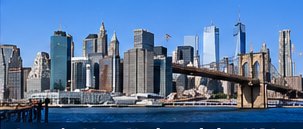
A central location of modern Jewish life
The United States is home to one of the world’s largest Jewish populations, with Jewish communities ranging from highly observant to secular and culturally affiliated. The history includes immigrants from Central and Eastern Europe, Sephardi and Mizrahi communities, refugees from persecution and families whose roots in America go back centuries. New York became a particularly important center because its ports, neighborhoods and labor markets attracted successive generations. Jewish Americans have contributed to business, science, culture, social movements and politics while also experiencing antisemitism.
New York beyond stereotypes
A 2023 community study counted about 1.372 million Jewish people in an eight-county New York area covering the city and several surrounding counties. This is not identical to New York City’s population, and researchers use different definitions and geographies. Brooklyn and Manhattan contain many Jewish households, but Queens, the Bronx, Staten Island, Long Island and Westchester are important too. Orthodoxy, Hasidic movements, Reform, Conservative, Reconstructionist and unaffiliated communities coexist in the wider region.
Synagogues, schools and social services
Jewish life includes day schools, yeshivot, summer camps, university organizations, cultural centers, museums, charities and organizations serving older people or immigrants. Synagogues range from small congregations to prominent historic buildings. Yiddish remains visible in some Hasidic neighborhoods, while Hebrew is taught for prayer, study and links with Israel. Jewish food traditions have also become part of the city’s wider cuisine, from bagels to delicatessens, although no single food can represent the diversity of Jewish Americans.
United States population estimates
US Jewish population estimates vary by definition. The American Jewish Year Book reported an estimate of about 7.46 million for 2023, while some studies produce different figures depending on whom they include. A careful comparison states whether it counts religious identity, cultural identity, people with Jewish parents or all residents of Jewish households. New York metropolitan estimates likewise differ if the region is defined as eight counties or as a larger metropolitan statistical area.
Connection to Israel and public debate
American Jews hold varied views about religion, political parties, Israel, antisemitism and the meaning of Jewish identity. Some are strongly attached to Zionism, others are critical of Israeli governments or of Zionism itself, and many resist reducing Jewish public life to any one political question. Holocaust education, civil rights work and local charitable networks remain important. The New York story is best told through this diversity rather than through a picture of one uniform, wealthy or politically identical community.
Sources
October 2026