
The Second Temple in Jerusalem: building, worship and destruction
After the Babylonian exile
The Second Temple was the central Jewish sanctuary in Jerusalem during the Persian, Hellenistic and Roman periods. Jewish tradition links its rebuilding to the return from Babylonian exile and dates the completion to the late sixth century BCE, commonly around 516 BCE. It replaced the First Temple, traditionally attributed to King Solomon and destroyed by Babylonia in 586 BCE. The Second Temple was not one unchanging building: its precincts and political role developed over several centuries as different rulers controlled Judea.
Priests, pilgrimage and ritual
The Temple served as a center of sacrifice, priestly ritual and pilgrimage festivals, especially Passover, Shavuot and Sukkot. People from Jerusalem, other parts of Judea and diaspora communities traveled there with offerings. Priests conducted ceremonies under a complex system of purity rules and sacred spaces. Religious life was not confined to the Temple: synagogues, study houses and household practices were also important. Different Jewish groups debated law, authority and the appropriate relationship between religious leaders and political power.
Herod’s rebuilding project
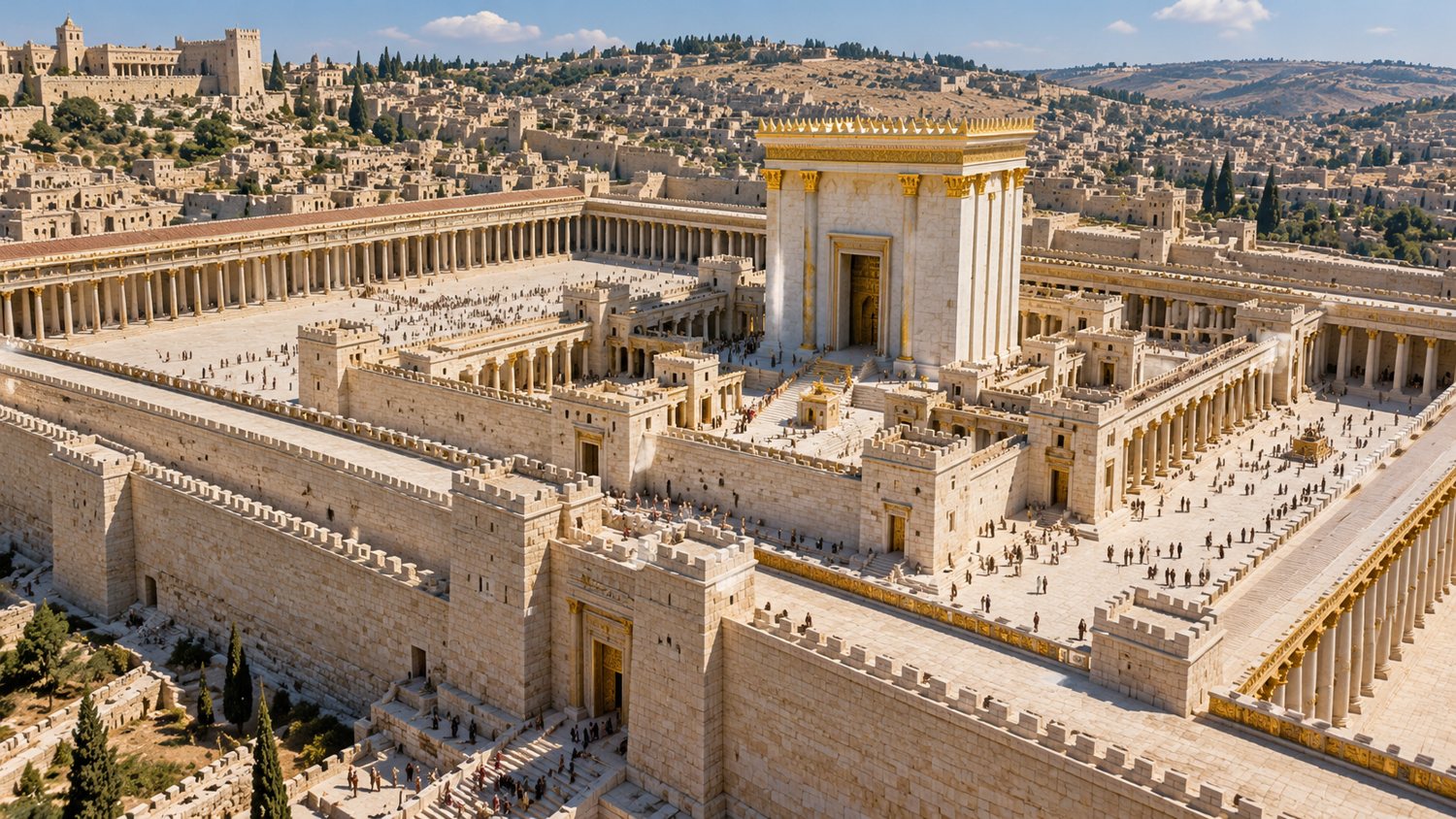
In the late first century BCE, Herod the Great began an ambitious renovation and expansion of the Temple complex, creating enormous retaining walls and a broad platform. The surviving Western Wall is part of the retaining system around the Temple Mount/Haram al-Sharif, not a surviving wall of the ancient sanctuary building itself. Reconstructions of the Temple’s appearance draw on Josephus, later texts and archaeological finds, but many details are debated. Illustrations should be labeled as reconstructions rather than photographs of an ancient building that no longer exists.
The destruction of 70 CE
During the First Jewish–Roman War, Roman forces under Titus captured Jerusalem in 70 CE and the Temple was destroyed. The catastrophe changed Jewish religious institutions and sharpened processes through which prayer, Torah study and rabbinic teaching became central. The ancient site remains sacred to Jews, while the elevated compound today also contains major Muslim holy places. Discussions of archaeology and worship there require respect for the historical significance and present religious sensitivities of both traditions.
What archaeology can and cannot show
Excavations around Jerusalem have uncovered streets, coins, ritual baths, inscriptions and architectural remains illuminating life in the Second Temple period. The finds help reconstruct trade, urban growth and religious practice, but they do not settle every question about political sovereignty or the exact form of sacred structures. Museum models can help visitors understand the scale of Herod’s building works if their interpretive nature is made clear. A strong account combines archaeology, ancient writings and awareness of the site’s ongoing significance.
Sources
October 2026