
The Eisenberg family and the chief rabbis of Vienna
Paul Chaim Eisenberg is an important figure in the postwar history of Austrian Jewry. Born in Vienna in 1950, he came from a rabbinic family. His father, Akiba Eisenberg, had arrived in Austria after the Second World War and served as Vienna’s chief rabbi from 1948. Paul Chaim initially studied mathematics and statistics before completing his religious training. In 1983 he succeeded his father as chief rabbi of the Israelitische Kultusgemeinde Wien, the Jewish Community of Vienna. His tenure lasted more than three decades, making him one of the best-known Jewish religious leaders in modern Austria.
A family of rabbis
The job of a chief rabbi involves much more than leading prayers. It can include legal and ethical questions, Jewish education, pastoral work, community ceremonies, public representation and encounters with other religious groups. Eisenberg became known for combining observant Orthodox Judaism with an accessible public style. His books, lectures, humour and musical appearances introduced Jewish tradition to people who would rarely enter a synagogue. From 1988 he also held the chief rabbi role for the Austrian federation of Jewish communities, a distinct institutional position from the chief rabbinate of Vienna.
Three decades of leadership
Eisenberg retired from the Vienna position in 2016 after 33 years of service. This was not the same as withdrawing from public life. Contemporary reporting said that he continued to hold responsibilities at the Austrian federation level. Arie Folger succeeded him as chief rabbi in Vienna in September 2016. A further transition followed when Jaron Engelmayer assumed the Vienna office in 2020. Keeping these different appointments clear matters, because accounts that simply call Eisenberg the “current chief rabbi” can mislead readers about who is responsible for the city’s congregation at a given date.
Succession and the 2026 appointment
On 17 June 2026, the board of the Jewish Community of Vienna selected Rabbi Yaron Nisenholz as its next chief rabbi and the rabbi of the Stadttempel. Nisenholz had served in Basel, Switzerland, including as that city’s chief rabbi, and later worked as a community rabbi in Tel Aviv. His arrival was scheduled for the autumn, after the High Holy Days. The selection came after an international application process and hearings. Community president Oskar Deutsch thanked the departing Jaron Engelmayer and described the transition as part of strengthening a diverse congregation.
The historical community
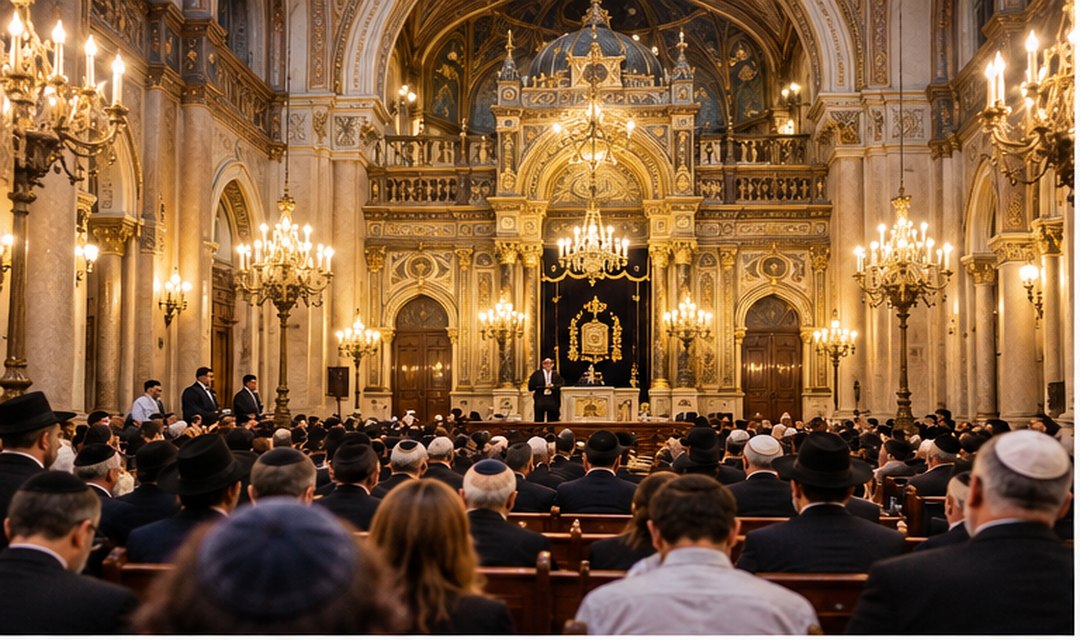
To understand these developments, one must also understand Jewish Vienna. There were Jewish communities in the medieval city, but violence and expulsions repeatedly disrupted them. The nineteenth century brought legal emancipation and a striking flourishing of Jewish education, business, music, literature and professional life. The Stadttempel was inaugurated in 1826. Under Nazi rule after 1938, Jewish institutions were destroyed, property was stolen and tens of thousands were deported and murdered. The Stadttempel survived as the only major synagogue building of its kind in Vienna. Its restoration was completed for its bicentenary in 2026.
Jewish Vienna today
Today the IKG is responsible for a broad network of religious, educational, cultural and social services. The Zwi Perez Chajes School, the Maimonides care centre, social assistance and community activities help sustain everyday Jewish life. Leopoldstadt remains an important neighbourhood for Jewish Vienna. Immigration from Eastern Europe and the former Soviet Union has contributed to the community’s recovery and diversity. Seen in this setting, Eisenberg’s family history and the succession of Vienna’s chief rabbis are not merely a list of names: they are part of the larger story of continuity, trauma, renewal and civic belonging in Austria.
Family and community context
Akiba Eisenberg served as chief rabbi of Vienna from 1948 until his death in 1983. The task was closely tied to the reconstruction of Jewish community life after Nazi persecution and the destruction of prewar institutions. His son Paul Chaim Eisenberg, born in Vienna in 1950, studied mathematics and statistics before his rabbinical training in Jerusalem. He succeeded his father in 1983 and remained the Vienna chief rabbi until 2016, building public bridges through teaching, dialogue, music and community ceremonies.