
The 1948 war: Israeli independence and the Palestinian Nakba
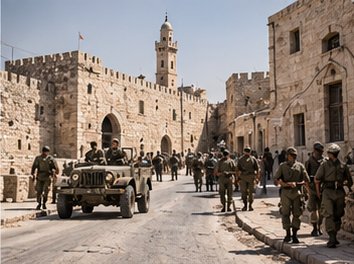
The end of the British Mandate
The war of 1948 took place as British rule in Palestine ended and competing national movements struggled over territory and political sovereignty. The United Nations General Assembly voted in November 1947 to recommend partition into Jewish and Arab states with a special international regime for Jerusalem. Jewish leaders accepted the plan as a basis for statehood, while Arab leaders rejected it as unjust. Fighting between communities escalated before British withdrawal. The conflict was shaped by decades of immigration, land disputes, colonial administration and competing claims to national self-determination.
The declaration of Israel
On 14 May 1948, David Ben-Gurion declared the establishment of the State of Israel. The following day, armies from neighboring Arab states entered the war, joining fighting that had begun months earlier. Israeli forces fought Egyptian, Jordanian, Syrian, Iraqi and other forces in a series of campaigns that shifted front lines repeatedly. For Israelis, victory meant survival and national independence after persecution and the Holocaust. For Palestinians, the same war marked the Nakba, or catastrophe, including mass displacement and the loss of homes and communities.
Refugees, civilians and disputed histories
Roughly 700,000 Palestinians became refugees or were displaced during the war, although estimates and explanations for individual localities vary. Historians examine flight from combat, expulsions, fear and other causes rather than offering one explanation for every town. Jewish residents also fled or were expelled from areas captured by Arab forces, including Jerusalem’s Jewish Quarter. The effects on families, property and cultural heritage endured long after the fighting. A serious account must not erase either Israeli independence or Palestinian suffering.
Armistice lines and Jerusalem
Armistice agreements reached in 1949 established military lines that later became known as the Green Line. They were not accepted as permanent political borders. Jerusalem was divided, with Israel controlling the western part and Jordan the eastern part including the Old City. Many questions remained unresolved: Palestinian refugees, access to holy places, recognition, security and future borders. These disputes helped shape later wars, peace negotiations and international diplomacy.
Commemoration and historical study
Yom Ha’atzmaut, Israel’s Independence Day, and Nakba Day express profoundly different historical memories. Museums, national archives, eyewitness accounts and diplomatic documents are essential for understanding why the same events carry such different meanings. Readers should check dates carefully, separate 1947–1948 civil fighting from the later interstate phase, and avoid attributing every decision to an entire population. The conflict is still politically contested, which makes precise source criticism especially important.
Sources
October 2026