The Abraham Accords Declaration: diplomacy, normalization and a changing region
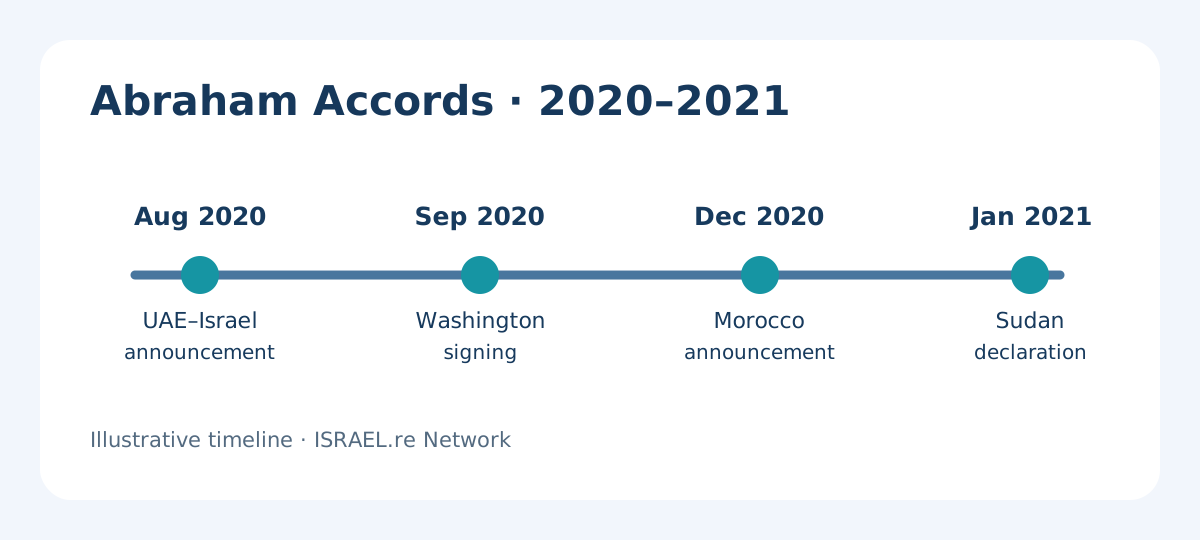
The Abraham Accords Declaration was signed at the White House in Washington on September 15, 2020. It accompanied a significant diplomatic development: Israel, the United Arab Emirates and Bahrain publicly moved toward normalized relations, with United States mediation. The declaration appeals to coexistence, human dignity, religious liberty and practical cooperation. It is essential, however, to distinguish that statement of shared principles from the separate bilateral agreements negotiated by the participating states. The documents form a connected diplomatic initiative, but they do not all have the same legal meaning or establish identical obligations.
The ceremony and its historical setting
President Donald Trump hosted Israeli Prime Minister Benjamin Netanyahu, Emirati Foreign Minister Abdullah bin Zayed Al Nahyan and Bahraini Foreign Minister Abdullatif bin Rashid Al Zayani. Israel had previously signed peace treaties with Egypt in 1979 and Jordan in 1994. The 2020 initiative was therefore not the first Arab-Israeli peace arrangement. It was distinctive because Gulf governments chose overt diplomatic normalization while the wider Israeli-Palestinian conflict remained unresolved.
What the declaration actually says
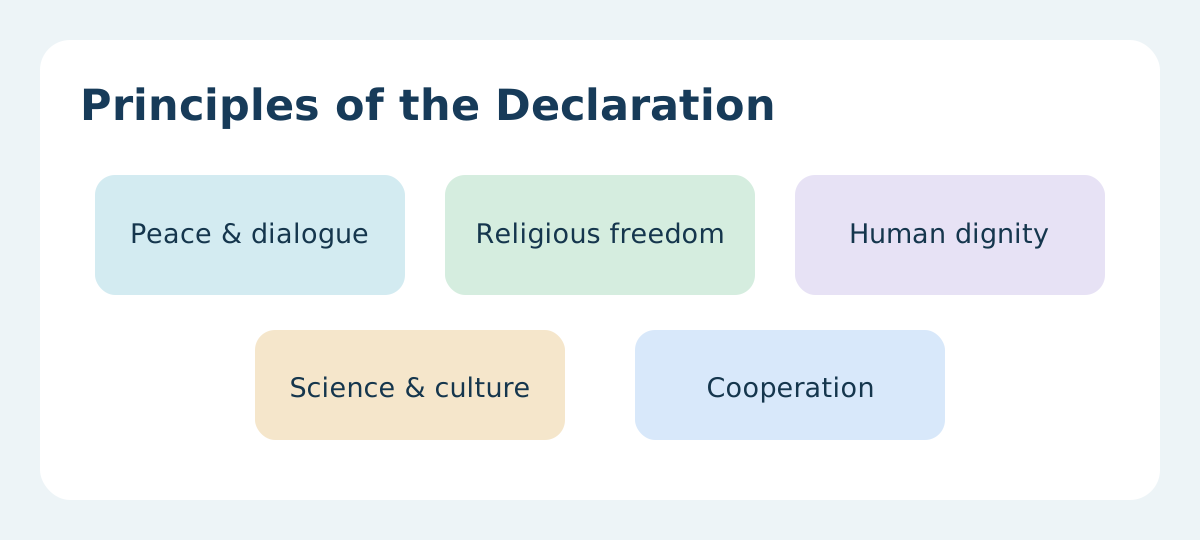
The declaration is concise and deliberately broad. It emphasizes the maintenance and strengthening of peace through mutual understanding and respect for human dignity. It supports religious freedom and interfaith dialogue among Judaism, Christianity and Islam, alongside broader cultural exchanges. Its authors identify science, art, medicine and commerce as ways to bring societies closer. They reject radicalization and conflict and express a desire to improve the prospects of future generations. These are important diplomatic aspirations, but the text does not itself provide a detailed schedule of diplomatic appointments, commercial rules or security commitments.
Separate documents have separate roles
A common misunderstanding is to treat the Abraham Accords as one uniform peace treaty. The general declaration states shared principles. Israel and the United Arab Emirates also signed a distinct agreement covering peace, diplomatic relations and full normalization. Bahrain and Israel adopted their own document concerning peaceful cooperation and the development of official ties. Each document must be interpreted on its own terms. A careful historical account distinguishes broad symbolic commitments from provisions that regulate concrete relations between two governments. Doing so helps readers assess what was promised, what was legally established and what still depended on future decisions.
Why normalization became attractive
Regional interests help explain the initiative. Participating governments recognized opportunities involving technology, trade, tourism, investment and scientific cooperation, while also considering security and geopolitical challenges. American diplomacy helped make the agreements possible and gave the signing considerable international visibility. Supporters argued that open relations could produce tangible benefits and create more channels for regional dialogue. Critics questioned whether strategic and economic cooperation could address the underlying demands of societies affected by unresolved political conflicts. Both perspectives are relevant: normalized state relations can create opportunities without automatically delivering comprehensive peace.
Israel and the United Arab Emirates
The Israeli-Emirati relationship illustrates the practical possibilities opened by normalization. Official visits, flights, business initiatives and university contacts became more visible. Discussions and projects have touched on water technology, health care, entrepreneurship, finance and digital infrastructure. Yet diplomatic announcements should not be mistaken for completed projects. Some initiatives develop slowly, some change direction and others encounter economic or political difficulties. The lasting significance of the agreement therefore depends not only on ceremonies and investment pledges but also on institutions, regulation, personal relationships and sustained confidence during difficult periods.
Bahrain joins the process
Bahrain's participation gave the September 2020 ceremony broader regional weight. The kingdom joined an approach that allowed direct diplomatic interaction with Israel and the development of official cooperation. Its geographic position in the Gulf means that its decisions may carry significance beyond its comparatively small population. Nevertheless, Bahrain's political circumstances and priorities are not identical to those of the Emirates. Treating the two countries as interchangeable would obscure the important differences in domestic governance, commercial interests and the pace of implementation. Every normalization relationship develops through its own institutions and political choices.
Morocco and Sudan followed different paths
Morocco announced the renewal of official ties with Israel in December 2020. The relationship has a distinctive historical dimension because of the long heritage of Jewish communities in Morocco and the many Israelis with Moroccan family roots. The diplomatic context also involved the disputed status of Western Sahara. Sudan entered the normalization process as well, but domestic political upheaval and subsequent warfare complicated the implementation of announced commitments. These cases demonstrate why participation in the Abraham Accords process should not be presented as proof that every country has reached the same level of stable diplomatic relations.
The Palestinian question
One of the initiative's central controversies concerns Palestinian rights and national aspirations. Earlier Arab diplomatic approaches frequently linked normalization with Israel to progress toward a settlement of the Israeli-Palestinian conflict. The 2020 agreements changed that sequence for the participating countries. Advocates believe that regional relationships might eventually foster dialogue and encourage compromise. Opponents contend that normalization without corresponding advances for Palestinians could weaken incentives to negotiate core political issues. A balanced account cannot simply erase this disagreement, because it helps explain why government celebrations and public reactions in the region have sometimes differed sharply.
Conflict tests diplomatic resilience
Serious violence and political crises after 2020 challenged the optimistic language of the signing ceremony. Diplomatic channels may remain valuable precisely when governments disagree strongly or face intense pressure from their populations. At the same time, the continuation of formal relations does not prove that broader reconciliation has taken place. Public opinion, cultural contact, commercial exchange and state policy can move at different speeds. Evaluating the accords requires attention to all these dimensions, including the limits of cooperation under pressure. No single trade statistic or summit photograph can tell the full story.
How history may judge the accords
The Abraham Accords marked a substantial change in the diplomatic landscape of the Middle East. They enabled official ties, created new routes for cooperation and challenged assumptions about the sequencing of regional peace initiatives. Their long-term impact remains dependent on political stability, public confidence and progress on wider conflicts. It would be inaccurate either to describe the declaration as the end of regional conflict or to dismiss normalization as meaningless. The September 15, 2020 declaration is best understood as the opening of an important, contested and unfinished chapter in regional diplomacy.