The Star of David: history, meaning and Jewish identity
The Star of David is one of the most recognizable symbols associated with Judaism and the State of Israel. In Hebrew it is called Magen David, or Shield of David. Its six points are formed by two overlapping equilateral triangles. The simple geometry gives the design a distinctive appearance, but the story behind it is anything but simple. Hexagrams appeared in several cultures before the shape became widely recognized as a Jewish emblem. Its history involves religious interpretation, decoration, communal institutions, the rise of modern nationalism, persecution, and the continuing expression of Jewish identity. A careful account separates the age of the geometric design from the much later history of its specific communal meaning.
The geometry of a six-pointed star
Two triangles pointing in opposite directions create six external points and a central hexagon. The resulting figure can be drawn with a compass, woven into textiles, carved into stone, or engraved on metal. Because the pattern is symmetrical, makers in many places found it attractive for architectural ornament and manuscript decoration. A hexagram found on an ancient building is not by itself evidence of a Jewish connection. Historians need to examine the archaeological setting, any inscriptions, the date of manufacture, and whether the motif appears alongside other recognizable cultural elements. A symbol's visual form and its socially understood meaning are separate historical questions.
Did King David use the star?
The familiar name points to the biblical King David, but there is no reliable historical proof that his actual shield carried the modern hexagram. Stories connecting the shape directly to David often belong to later legendary or symbolic traditions. Gershom Scholem, an influential historian of Jewish mysticism, emphasized that the hexagram's emergence as a Jewish emblem should not be confused with later explanations of its origin. The expression Magen David also has a history in Jewish religious language and traditions. That rich background matters, but it does not establish the existence of a specific six-pointed royal shield in ancient Israel.
A motif used in more than one culture
The six-pointed figure has appeared in artistic, religious, and protective settings far beyond Jewish communities. It can be found in a variety of historical environments in Asia and around the Mediterranean. In some contexts it is simply decorative, while in others people have assigned it mystical or protective associations. Early examples in Jewish artistic settings also exist. Their presence demonstrates that Jewish artists knew and used the pattern, not that every Jewish community treated it as its primary emblem. The distinction is important because historical symbols do not necessarily acquire an exclusive meaning when they first appear.
The Jewish community of Prague
Prague played an important role in making the star more publicly identifiable with Jewish communal life. Accounts of Jewish banners in the city reach back to the late medieval period, although the surviving evidence and the precise designs require careful interpretation. By the early modern period the hexagram became increasingly visible in Prague's Jewish communal symbolism. From there its adoption spread into other parts of Central Europe. Historians sometimes differ about the earliest documented flags and their dates. The broader development is less controversial: the Prague tradition helped transform an existing geometric sign into a visible mark of community.
From local motif to shared emblem
During the eighteenth and especially nineteenth centuries the star became more common on synagogues, community seals, books, and gravestones. Jewish communities in Europe were negotiating legal emancipation, new civic rights, and questions of cultural belonging. A clear, recognizable symbol could represent communal identity in an increasingly public setting. The hexagram was visually distinctive and already familiar in some Jewish environments. Its spread was gradual, however, and not every community adopted it in the same way. Other Jewish images remained important, especially the menorah, whose historical association with the biblical sanctuary and Temple is substantially older.
The menorah is not the same symbol
The Star of David and the menorah often appear in the same conversations about Jewish identity, but their histories differ. The seven-branched menorah has a clear biblical and ritual background. The Star of David became particularly important as a communal emblem and later as a national one. Israel's official state emblem depicts the menorah, while its national flag displays the Star of David. These choices make sense in light of the two symbols' different trajectories. Treating them as interchangeable erases useful historical distinctions, even though people may connect both to their Jewish identity today.
The Zionist movement
The modern Zionist movement gave the star an additional political meaning. At the First Zionist Congress in Basel in 1897, it became associated with the language and imagery of Jewish national self-determination. Blue and white also entered the growing visual vocabulary of the movement, drawing on existing Jewish cultural and religious references, including prayer-shawl imagery. This was not simply the revival of a continuously used ancient national flag. Rather, activists selected and reinterpreted symbols that could communicate across communities. The star's ability to function in religious, cultural, and national settings helped explain its prominence.
A symbol imposed during Nazi persecution
Under Nazi rule, Jews in many occupied or controlled territories were forced to wear identifying badges, including the yellow star marked with the German word Jude. The badge was imposed by an antisemitic state as an instrument of humiliation, exclusion, and persecution. It must not be confused with the voluntary use of a Jewish emblem by a congregation or an individual. The United States Holocaust Memorial Museum documents the longer European history of discriminatory badges and explains that their shapes varied. The Nazi-era star was one particular, devastating chapter in that history, and its consequences remain central to Jewish historical memory.
The national flag of Israel
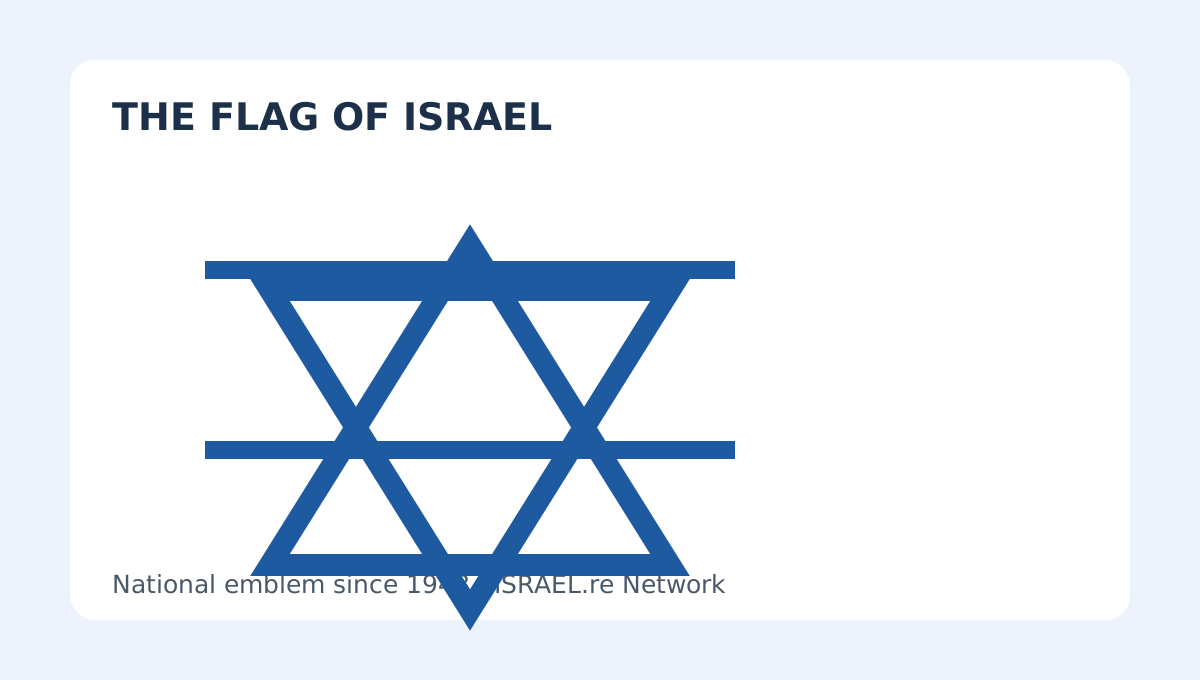
When the State of Israel was established in 1948, the blue-and-white flag featuring the Star of David became its national flag. A dark blue hexagram sits between two horizontal blue stripes on a white field. The stripes are commonly associated with the tallit, the Jewish prayer shawl, although the flag's design emerged through several nineteenth- and twentieth-century stages. On the flag, the star is an emblem of the Israeli state. On a necklace or in a synagogue it can express personal faith or heritage rather than any particular political position. Interpreting the sign responsibly requires attention to the circumstances in which it appears.
Synagogues, homes and personal jewelry
Today the Star of David is visible on synagogue exteriors, Jewish books, memorials, gravestones, ceremonial objects and jewelry. Some people wear it as an expression of religious identity; others emphasize family heritage or solidarity with Jewish communities. It can also be connected to Israel or to the memory of relatives who faced persecution. The same image can carry multiple meanings for different people. It is therefore misleading to presume that everyone who displays the star holds an identical theological or political view. Symbols are part of lived culture, and their meaning develops through choices made by individuals and communities.
Mystical and religious interpretations
A variety of symbolic interpretations connect the two triangles with heaven and earth, directions in space, or divine attributes. Jewish mystical traditions have sometimes offered readings of the hexagram, but there is no single theological account endorsed by every Jewish movement. Modern popular explanations may also reflect more recent spiritual interests rather than original historical meanings. Such interpretations can still matter deeply to believers. An accurate encyclopedia article makes room for them while distinguishing spiritual interpretation from dated documentary evidence. The geometric form did not begin with one universally accepted explanation, and its later meanings should not be projected backward uncritically.
Magen David Adom
The name of Israel's emergency medical organization, Magen David Adom, means Red Shield of David. The organization's emblem uses a red six-pointed star in a humanitarian and medical setting. Here the motif identifies a service devoted to emergency care and the protection of human life. It has a distinct practical purpose from a national flag or religious decoration. This is a good example of how a symbol can gain institutional associations without losing its earlier meanings. The specific context, mission, and audience determine what viewers are likely to understand when they encounter it.
Memory, trauma and self-determination
In modern history the star carries memories of dramatically different experiences: voluntary Jewish communal identity, the coercion of Nazi persecution, and the public assertion of Jewish national self-determination. For survivors of the Holocaust and their descendants, the shape may evoke loss, defiance, continuity and renewed life. Those associations should not be flattened into a single slogan. Historical precision allows us to recognize that an imposed badge and a freely chosen emblem are not the same act, even when they share a six-pointed shape. The distinction respects both the victims of persecution and the diversity of contemporary Jewish experience.
Understanding the symbol today
The Star of David illustrates how a geometric motif can acquire meaning through centuries of use. Its history is tied to art, religion, community, migration, discrimination and nationhood. The six points are easy to reproduce, yet their cultural significance cannot be explained by geometry alone. A responsible history avoids claiming an unbroken, exclusive meaning from biblical times while acknowledging that the symbol has become profoundly important to many Jewish people. Its modern power comes from a long process of adoption, reinterpretation and remembrance, rather than from a single moment of invention.
Sources / מקורות / Источники
National Library of Israel Jewish Museum United States Holocaust Memorial Museum Israel Post: the Israeli Flag