
France and Israel: arms exports, Gaza, Iran and the dispute over the Paris Air Show
1 November 2026 • israel.re
A dispute about several different decisions
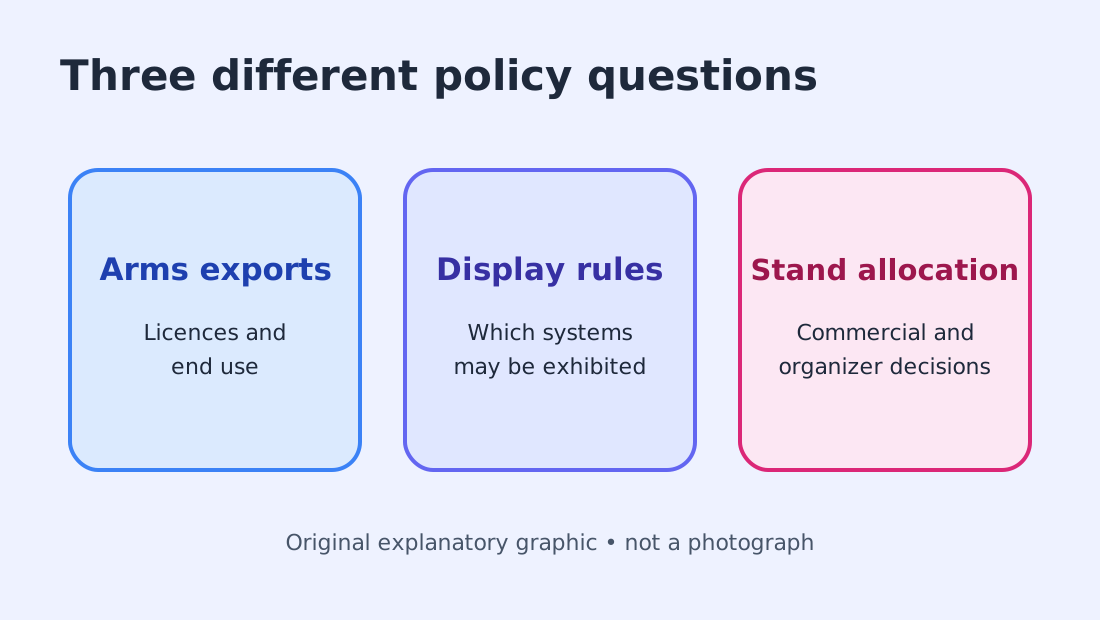
Relations between France and Israel have deteriorated as disagreements over the Gaza war have widened into diplomacy and defense trade. Three issues must be separated: French exports of military equipment to Israel, the rules governing Israeli exhibitors at arms fairs, and the future allocation of exhibition space at the Paris Air Show. A restriction on displaying offensive weapons is not an embargo on all trade. Likewise, an exhibition organizer's announcement that its halls are fully booked is not, by itself, proof of a politically motivated ban. These distinctions matter because the events involve different decision makers, different legal procedures and different kinds of evidence.
What was reported on October 30, 2026
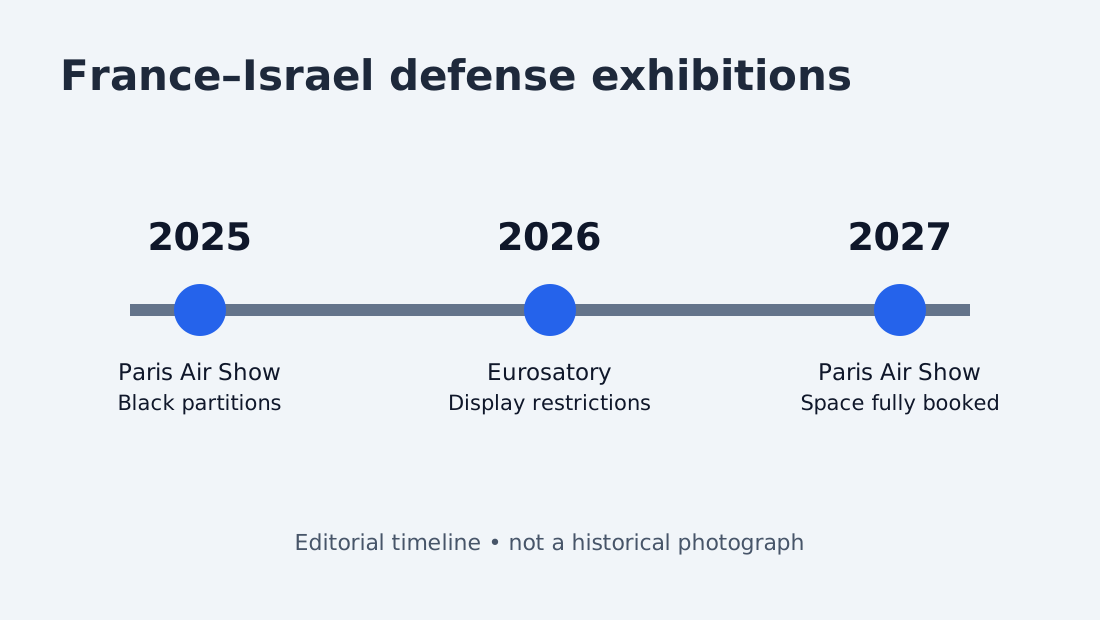
Israeli business publication Ctech reported that Israel Aerospace Industries, Rafael and Elbit Systems were told that no pavilion space was available for the Paris Air Show in 2027. These companies have exhibited at the show for many years, making the reported result commercially and politically significant. The organizer's own website says exhibition areas are fully booked. Israeli defense officials suspect the lack-of-space explanation conceals a political attempt to exclude their industry. That interpretation should be attributed to those officials rather than presented as established fact. At the time of writing there is no independently demonstrated finding that places were deliberately withheld from Israeli exhibitors.
Why Le Bourget matters
The next Paris Air Show is scheduled for June 14 through June 20, 2027, at Le Bourget. Although famous for aircraft, it also brings together the space industry, international supply chains, commercial aviation, military procurement organizations and representatives of national governments. An exhibition booth is not merely an advertising space. Engineers use such events to meet suppliers, firms discuss long-term maintenance contracts, and procurement officials compare solutions before tender processes begin. Losing a prominent position at a prestigious show can affect visibility and relationships. It does not necessarily eliminate the possibility of commercial meetings, bilateral visits or participation through other arrangements.
The black walls in June 2025
The argument has a concrete precedent. At the June 2025 Paris Air Show, authorities ordered partitions erected around the stands of several Israeli defense companies after disagreement about the display of offensive weapons. Black barriers covered highly visible pavilions shortly before the show opened. Associated Press documented both the walls and the French government's position. Israel's Defense Ministry called the move discriminatory and demanded that it be reversed. French officials linked the limitations to the humanitarian situation in Gaza and the presence of weapons considered offensive. The image of blacked-out booths became an international symbol, but it should not be confused with a complete prohibition on every Israeli company attending the event.
Companies and technology
Israel Aerospace Industries works across aerospace, satellites and defense; Rafael is closely associated with missile-defense and other military technologies; and Elbit Systems manufactures a wide range of electronics, sensors and systems for defense customers. Smaller Israeli contractors were also affected by controversies surrounding the fairs. Different companies make very different products. A radar designed to detect incoming rockets, a reconnaissance sensor and a system intended to strike a target cannot responsibly be treated as identical. Nevertheless, even equipment described as defensive can raise questions about end users and deployment. That makes transparent export classifications, end-use verification and publicly explainable rules especially important.
Eurosatory brought another round of restrictions
In June 2026 French authorities limited what Israeli companies could display at the Eurosatory defense exhibition in Paris. Reuters reported French confirmation of limits to air- and missile-defense equipment. Israel's Defense Ministry said the conditions also prevented official Israeli government participation and the establishment of a national pavilion. The ministry characterized the restrictions as discriminatory. France did not publicly confirm every element of the Israeli description in the reporting reviewed. Readers should therefore distinguish between a restriction acknowledged by French officials and additional claims made by the Israeli government. This episode demonstrates that the friction did not begin with the 2027 Paris Air Show registration process.
Macron and the Gaza war
President Emmanuel Macron urged a political solution and an end to fighting in Gaza, where civilians endured severe destruction, displacement and a humanitarian emergency. In October 2024 he called for stopping the supply of weapons used in combat operations in Gaza, arguing that demands for a ceasefire should be matched by arms-export policy. Israel rejected this approach and emphasized its right to defend its population against armed threats following the October 7, 2023 attacks led by Hamas. The conflict raises genuine legal and ethical questions about military necessity, proportionality, civilian protection and the responsibilities of supplier states. Reporting should describe those questions without assuming that a political position settles every legal allegation.
Did France actually supply weapons?
Claims that France supplied nothing to Israel, or that every export continued unchanged, oversimplify the evidence. SIPRI reports no French deliveries of major conventional weapons to Israel during 2020–2024, while noting the supply of components. The French government subsequently published information about parts exported in 2024 and argued that their uses related to civilian protection or onward re-export. That explanation has itself been scrutinized by critics. Major weapons transfers, spare parts, dual-use equipment and components for multinational production chains are not interchangeable categories. A serious assessment must consider the type of material, export authorization, destination, time period and intended final user rather than relying on a single sweeping statement.
How the Iran conflict complicated the debate
The conflict involving Israel and Iran sharpened the security discussion as the 2025 exhibition opened and in subsequent months. Israel argues that Iranian missiles, drones and support for armed groups represent direct threats. France has expressed concern about regional escalation, civilian harm and broader international security. A distinction between air defense and offensive capabilities has therefore become central to French exhibition restrictions. Yet military technology does not always fit neatly into political labels: a system may perform surveillance, interception or strike-related functions depending on configuration and deployment. Clarity about specific exhibited products matters more than slogans about whether an entire defense industry is offensive or defensive.
Trade policy is not the same as exhibition access
An arms-export license is issued through governmental procedures; exhibition access involves contracts with organizers and may also be influenced by public-security and government requirements. These rules can overlap, but their legal consequences differ. A company's ability to display a product is not a government authorization to export it. Equally, an export restriction is not automatically a ban on meeting prospective customers at a trade show. Disputes over Israeli participation have reached French courts in earlier years. That legal history makes it particularly important to identify whether a new decision comes from an organizer, a ministry, a court or a commercial contract.
Arguments made in France and Israel
Supporters of French restrictions argue that an international defense fair should not ignore allegations of humanitarian-law violations and the scale of civilian suffering in Gaza. Opponents argue that selective restrictions undermine equal treatment and risk turning a commercial event into a venue for political exclusion. Israeli officials have suggested that economic competition may also be involved. That is a claim requiring evidence, not a demonstrated explanation. Both sides invoke principle: France emphasizes accountability and diplomatic pressure, while Israel emphasizes security needs and non-discrimination. A credible article should present the grounds of the disagreement, recognize civilian suffering on all sides and resist dismissing complex legal issues with rhetorical accusations.
What can be established as of November 2026
The partitions at the 2025 Paris Air Show are documented. So are the limits placed on Israeli displays at Eurosatory in 2026. The official Paris Air Show website says its 2027 exhibition space is fully booked, and Israeli industry sources report that major Israeli companies were unable to secure large stands. It remains uncertain whether a political exclusion decision was taken for the 2027 fair, whether any appeal or alternative participation will succeed and how the organizers will handle future inquiries. Those uncertainties belong near the top of an article, not buried in a footnote after a categorical headline.
The bigger question for the next show
The dispute places a spotlight on how international trade fairs make decisions during war. Clear written criteria for exhibitors, published explanations of product restrictions and meaningful avenues for appeal would help separate political judgment from operational constraints. Those measures would not resolve the Gaza war or Israeli-French diplomatic differences. They would, however, allow the public to distinguish between ordinary capacity limits, restrictions applied under stated rules and treatment that might be discriminatory. The story is therefore not only about which companies can rent space in Paris. It is also about transparency, legitimate security interests, the obligations attached to military commerce and the credibility of institutions that claim to apply common standards.
What readers should watch next
Several developments could clarify the matter before June 2027. Organizers could publish a detailed account of allocation policy and any waiting-list procedure. Israeli firms could disclose documentary correspondence or announce an appeal. French authorities could identify product categories that remain permissible or explain whether security instructions affect stand allocation itself. Commercial partners may also announce meetings elsewhere in Europe. Until such evidence appears, the most accurate description is a serious dispute over reported lack of space against a well-documented background of previous restrictions, not an established blanket exclusion of all Israeli industry from French aviation events.