
Operation Machbesh: the 29 October 1956 parachute landing that opened the Sinai Campaign
29 October 2026 · 70 years later
A specific operation within a much larger war
On 29 October 1956, Israel launched a military action given the Hebrew code name Makhbesh, often transliterated Machbesh and literally meaning a press or pressing machine. The action was not the name of the entire Sinai War. Rather, it designated the airborne landing by Battalion 890 of the Israel Defense Forces near the eastern approaches to the Mitla Pass in Egyptian Sinai. That distinction matters because accounts often use Operation Kadesh, the Sinai Campaign and the Suez Crisis interchangeably. Kadesh was the broader Israeli operation, whereas the Suez Crisis also involved British and French military intervention against Egypt. The parachute landing provided the opening move and helped shape the subsequent diplomatic crisis.
Why the region was already in crisis
The confrontation emerged from several overlapping disputes rather than a single event. Israeli communities faced violent cross-border raids, some attributed to fedayeen operating from Egyptian-controlled territory, while Egyptian forces and Israeli units had been involved in a cycle of reprisals. Egypt restricted Israeli shipping through key maritime routes, including the Straits of Tiran. Israel regarded that restriction as a strategic danger, particularly to access to Eilat and the Red Sea. Egypt, for its part, sought to defend its sovereignty and confronted former colonial powers that had long controlled strategic infrastructure. The perspectives of civilians and soldiers on either side were not identical to those of their governments.
Nasser and the Suez Canal
On 26 July 1956 Egyptian president Gamal Abdel Nasser announced the nationalisation of the Suez Canal Company. For Egyptians, the decision became a powerful expression of sovereignty and the right to control a vital national asset. In London and Paris, leaders interpreted it as a challenge to their strategic and commercial influence. France also opposed Egyptian support for Algerian independence fighters. The United Kingdom feared losing influence over a major international shipping corridor. Israel had separate security and maritime concerns. These motives converged, but they should not be confused or presented as an uncomplicated defensive response by one united alliance.
The secret diplomatic arrangement
In October 1956 Israeli, French and British representatives reached a secret understanding at Sèvres, near Paris. The Israeli advance into Sinai would be followed by an Anglo-French demand that Egyptian and Israeli forces pull back from the canal, creating a pretext for intervention. The resulting coordination remained concealed from much of the public at the time. This background is essential to understanding why a comparatively small parachute drop near a distant mountain passage had such large international consequences. Historical research and declassified Israeli defence documents show that the operation had a military purpose as well as a calculated role in the wider diplomatic scenario.
What Battalion 890 was ordered to do
The Israeli plan called for the deployment of Battalion 890 from the Paratroopers Brigade near the eastern end of the Mitla Pass, one of the roads crossing the mountainous interior of Sinai toward the canal. Major Rafael Eitan commanded the battalion; Ariel Sharon commanded the larger Paratroopers Brigade, which was to advance overland and link up with the airborne force. Aircraft transport, navigation, communications and subsequent resupply all posed difficulties. The operation placed a relatively isolated unit deep inside territory controlled by Egypt. The landing did not itself conquer all of Sinai or secure the canal, and confusing those achievements would distort the military chronology.
The afternoon of 29 October
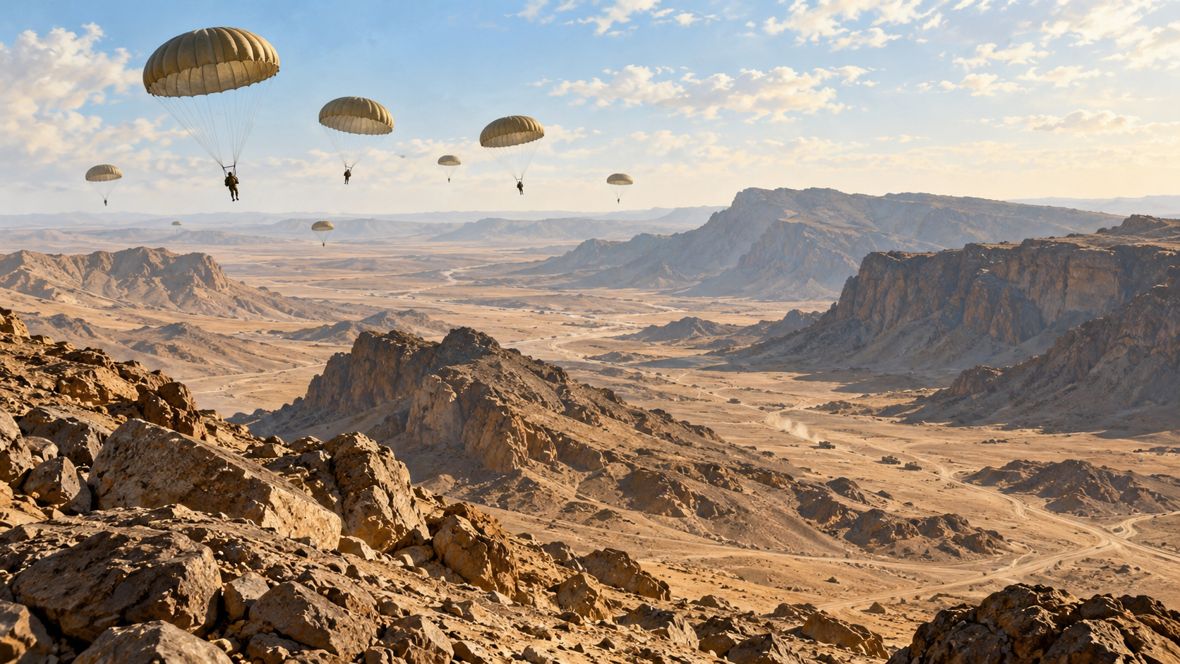
According to an IDF historical account, the first operational combat parachute drop began at approximately 16:59 on Monday, 29 October 1956. Paratroopers descended near the eastern approaches to the Mitla Pass and began organising their positions on difficult desert terrain. The operation was unusual for the young Israeli military because it combined airborne insertion with a coordinated ground advance. Equipment, communication, nightfall and the possibility of an Egyptian counterattack were immediate concerns. The soldiers were far from established supply routes. The landing also supplied a visible military development that Britain and France could invoke in the next stage of their prepared ultimatum.
The ground link-up and the Mitla fighting
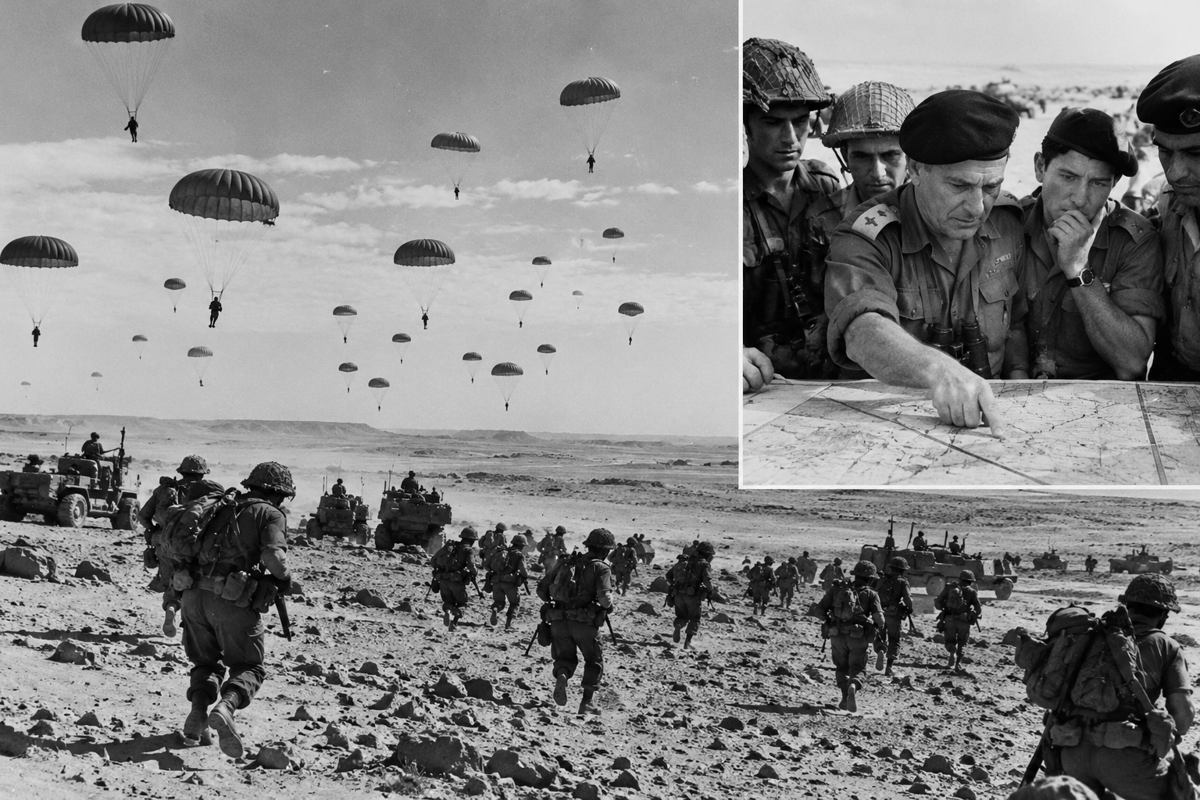
While Eitan's battalion held its location, the remainder of the Paratroopers Brigade moved westward across Sinai. The subsequent fighting around the Mitla Pass, particularly on 31 October, was a separate and deadly episode, not simply a continuation of the descent from the aircraft. The decision to enter the pass and the heavy losses suffered there later became subjects of military investigation and debate. Command responsibilities, incomplete intelligence and tactical judgement were discussed long after the campaign. A historical article must distinguish the success of getting the battalion onto the ground on 29 October from the much more controversial battle that followed.
Egypt's perspective and the human cost
For Egypt the incursion represented an invasion of its territory, occurring amid a struggle against foreign control of the canal. Egyptian soldiers defended positions in the peninsula, and the war affected civilians as well as military personnel. Arab accounts often call the wider conflict the Tripartite Aggression, reflecting the three states that attacked Egypt. The choice of name signals a difference in historical interpretation, not a different date. Casualties occurred among Egyptian and Israeli soldiers, and fighting also affected Egyptian towns beyond the initial landing zone. The Israeli Defense Ministry's historical timeline lists 182 Israeli military fatalities during the Sinai campaign; other publications use different tallies and definitions.
Britain, France and the international response
Britain and France issued their ultimatum after the Israeli advance and carried out attacks on Egyptian targets when Nasser rejected their demands. The Suez Crisis quickly became a test of power within the Cold War. The United States, although allied with Britain and France, opposed the intervention and applied considerable pressure for an end to hostilities. The Soviet Union also condemned the invasion. At the United Nations, diplomats called for a ceasefire and withdrawal. This response revealed the limits of older European imperial power and demonstrated that battlefield success did not necessarily translate into diplomatic success or continued territorial control.
Withdrawal and the United Nations
Israeli forces occupied Sinai during the brief campaign but did not remain there indefinitely. International pressure and negotiations led to withdrawal in stages, completed in March 1957. A United Nations Emergency Force was established to help supervise the aftermath of the confrontation. Navigation through the Straits of Tiran and border security remained important in later years. The canal crisis also enhanced Nasser's political standing despite Egypt's military setbacks. For Israel, the fighting reinforced the reputation of its armed forces, but at a cost measured in deaths, injury and long-term regional distrust. Neither outcome can be understood by studying the airborne landing alone.
What the photographs show
The images accompanying this article are modern editorial reconstructions, not pictures taken by a camera on 29 October 1956. They illustrate the terrain and the idea of airborne insertion without pretending to document an exact moment or named participant. Genuine historical photographs are held by Israeli government collections and institutional archives; their captions and licences need to be checked separately before reproduction. A particularly useful primary visual reference is the archive of IDF paratrooper photographs, while the official Ministry of Defense exhibition documents the campaign through maps, orders and photographs. Readers should avoid treating every desert picture labelled 1956 as evidence of Operation Machbesh itself.
Reading the sources critically
Official Israeli sources provide exact operational labels, the drop date, commanders and military objectives. They are indispensable for reconstructing the IDF's plan but naturally reflect an Israeli institutional perspective. Egyptian historical writing emphasises sovereignty, colonial intervention and civilian experience. Broader histories of the Suez Crisis examine the secret Sèvres arrangement and responses in Washington, Moscow and the United Nations. Comparing these accounts is more informative than presenting a single national narrative as an exhaustive history. The IDF's article on historic parachute operations explicitly names Makhbesh, while the Ministry of Defense's Kadesh exhibition describes the political planning.
Seventy years later
The anniversary on 29 October 2026 is seventy years after the initial landing. It offers an opportunity to examine the difference between a tactical success and the political consequences of armed conflict. Operation Machbesh is remembered in Israeli military history as a pioneering combat parachute drop. It is also part of the much larger story of Egypt's sovereignty, European intervention, the United Nations and the changing Middle East. Remembering the events accurately means identifying the original operation, separating it from the later Mitla battle, and acknowledging the experiences of people on both sides of the frontier.
Sources and further reading
- IDF: The first combat parachute jump — Operation Makhbesh(https://www.idf.il/אתרי-יחידות/חטיבת-הצנחנים/כל-הכתבות/2017/צניחות-בצה-ל-לאורך-ההיסטוריה/)
- IDF: What Was the 1956 Sinai Campaign?(https://www.idf.il/en/mini-sites/wars-and-operations/what-was-the-1956-sinai-campaign/)
- Israel Ministry of Defense Archives: Operation Kadesh(https://archives.mod.gov.il/Exhib/kadesh/Pages/default.aspx)
- Israel Ministry of Defense Archives: 1956(https://archives.mod.gov.il/timeline/Pages/1956.aspx)
- Suez Crisis — English Wikipedia(https://en.wikipedia.org/wiki/Suez_Crisis)