
Editorial update: 29 October 2026
Jewish Museum London: how objects tell the story of Jewish life in Britain
28 October 2026
A museum that connects communities
The Jewish Museum London is more than a collection of religious antiques. It is a cultural institution that explores the presence, creativity, struggles and achievements of Jewish people in Britain. Its exhibitions make an important argument: Jewish history is not a separate appendix to British history, but one of the many histories from which modern Britain has been formed. A prayer book, a suitcase, a family photograph or an ordinary kitchen utensil can speak about the movement of people, the preservation of traditions and the constant process of finding a home. For visitors who know little about Judaism, the museum provides an introduction grounded in human experiences rather than stereotypes. For Jewish visitors, it can offer a place to encounter the many different voices within their own heritage.
From Bloomsbury to Camden
The institution's roots go back to 1932, when scholars and collectors including Cecil Roth, Alfred Rubens and Wilfred Samuel established a Jewish museum in London. Its early work concentrated particularly on preserving ceremonial objects, historical documents and artistic treasures. Another important strand emerged in 1983 with the Museum of the Jewish East End, subsequently known as the London Museum of Jewish Life. That museum focused on the memories of immigrant neighbourhoods, family businesses, working lives and communities whose physical traces were gradually disappearing. The two museums merged in 1995, bringing together the history of religious objects and the social history of ordinary people. After redevelopment, a combined museum opened in Camden Town on 17 March 2010. The Camden building became an established venue for exhibitions, school activities and discussions about identity and belonging.
A longer and more varied British history
Jewish presence in England reaches back to the Middle Ages. Following persecution and expulsion in 1290, a lasting public Jewish community was re-established from the seventeenth century, when Jews were readmitted under Oliver Cromwell. Sephardi families with connections to Spain, Portugal and Amsterdam contributed to the renewal of communal life. In later centuries, Ashkenazi immigrants arrived from many parts of Europe, including large numbers escaping poverty, discrimination and violence in the nineteenth and early twentieth centuries. The East End of London became especially significant, with synagogues, newspapers, schools, workshops, charities and lively cultural networks. Jewish history in Britain also includes Welsh and Scottish communities, smaller regional congregations and newer arrivals from numerous countries. The museum's strength lies in treating these experiences as related without presenting them as identical.
What the collections preserve
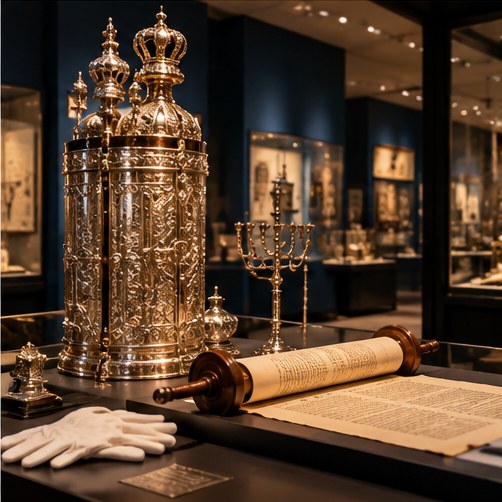
The museum describes a collection of approximately 35,000 objects, including Judaica, prints, drawings, photographs, oral histories and materials from everyday family and working life. Its nationally recognised ceremonial holdings are particularly significant. Among the highlighted treasures are an ornate Venetian synagogue ark and silver Torah ornaments associated with the Great Synagogue at Duke's Place, which was destroyed during the Second World War. Such objects illuminate craftsmanship, religious practice, migration and the relationship between a community and its institutions. They also remind us that not every surviving object spent its life in a museum: many were used in a synagogue, carried between countries, or treasured in homes. A visitor can therefore ask not only what something looks like, but who used it, why it mattered and what happened to the people around it.
The stories hidden in everyday things
Some of the museum's most moving examples are not luxurious or monumental. Its online project, Jewish Britain: A History in 50 Objects, includes objects linked to migration and settlement, such as a noodle-making machine brought from Russia, clothing carried across borders and a doll brought to Britain on the Kindertransport. These belongings can help younger audiences understand historical events on a personal scale. A child's doll may be small, but the journey behind it encompasses fear, rescue, separation and hope. A household machine may reveal what a newly arrived family cooked, how it earned a living, or how a language was maintained at home. A newspaper or a letter can show how neighbours organised politically or helped newcomers. Preserving such evidence means protecting ordinary lives from disappearing behind statistics and famous names.
Religion without reducing Jewish identity to religion
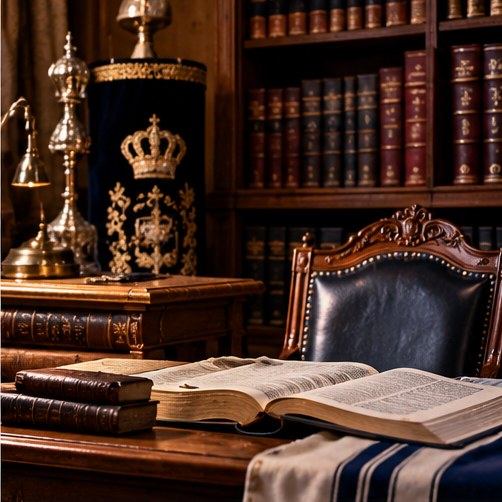
A central educational challenge is explaining Jewish festivals and practices without suggesting that all Jewish people observe them in the same way. Shabbat, the Jewish calendar, prayer, Torah reading and the use of ceremonial objects remain essential parts of Jewish cultural knowledge. At the same time, Jewish identity can be religious, secular, cultural, familial or a combination of these dimensions. British Jews include people of many levels of observance and many geographical backgrounds. The museum's materials are strongest when visitors can see this diversity for themselves. An exhibition about a Torah scroll may introduce religious meaning while also discussing metalwork, language and the history of its owners. A display about a festival may explore shared rituals alongside the distinctive customs of different families.
Refugees, antisemitism and remembrance
The museum also addresses difficult chapters of European and British history. Jewish refugees from Nazi persecution, Holocaust survivors and children who escaped through the Kindertransport left testimonies and objects that connect individual experiences to the catastrophe of the Holocaust. Teaching this history requires both accuracy and care. Exhibits and learning resources can make clear that victims were not merely numbers, but people with homes, professions, ambitions and relationships. The story does not end in 1945: survivors rebuilt lives, formed families and contributed to public culture in Britain. Education about antisemitism is another part of the museum's mission. Historical prejudice and contemporary hostility should be studied without treating Jewish communities solely through the lens of persecution. Art, humour, labour, religious debate and everyday happiness belong to the same history.
School programmes and the digital collection
For teachers, the museum provides structured materials on Jewish life and British Jewish history. Its learning programme has included school outreach, virtual classrooms, resource boxes and online materials with authentic community perspectives. The Inclusive Judaism initiative seeks to show Jewish diversity through real voices, rather than presenting one family's habits as universal. The online collections make it possible for students and researchers outside London to explore objects and their stories. Digital access cannot entirely replace the experience of examining an original artefact, but it can substantially broaden the museum's audience. A class in another country can use an object record to discuss migration, religious freedom or the consequences of war. This educational work continued even when the museum lacked a permanent public gallery.
Closure in Camden and a new beginning in 2026
Rising operating costs and long-term financial pressures led the museum to close its Camden building in 2023. This was a closure of a physical site, not the disappearance of the organisation or its collections. The museum continued to lend objects, organise educational activities and work with partner venues. In June 2026 it opened Two Rooms by Jewish Museum London at JW3 on Finchley Road in north London. The interim space contains a display called Tree of Life: Stories from Jewish Museum London's Collection, exploring Jewish Britain and the museum's own collecting history. Another opening exhibition examined the family behind J. Lyons, a business associated with Britain's popular tea shops and catering history. The British government announced support of up to one million pounds in June 2026 to strengthen outreach and assist planning for a new permanent home. A long-term location is being pursued with a target of 2030, but a future opening date is not a guarantee.
Visiting, studying and supporting the museum
As of October 2026, the museum's Two Rooms space is on the top floor of JW3, 341–351 Finchley Road, London NW3 6ET. The published general visiting hours are Sunday to Thursday, 12:00–19:00, with special closures possible; visitors should always check the museum website before travelling. Friday and Saturday are not listed among the regular opening days. The former Camden address should not be used as a current visitor destination. For those unable to visit, the museum's online exhibitions and collection database offer a substantial starting point. Supporting the museum does not necessarily mean making a donation: teachers, researchers, volunteers and people with family stories or relevant objects can all contribute to historical understanding. The institution matters because a society's memory becomes richer when minority histories are recognised as public history. The Jewish Museum London helps preserve that memory while encouraging conversation between generations and communities.
Sources and further reading
- Jewish Museum London – official website(https://jewishmuseum.org.uk/)
- History of the museum(https://jewishmuseum.org.uk/about-us/our-history/)
- Collections and Judaica(https://jewishmuseum.org.uk/Collections/)
- Two Rooms: exhibitions and visitor information(https://jewishmuseum.org.uk/whats-on/two-rooms/)
- Where to find us(https://jewishmuseum.org.uk/about-us/where-to-find-us/)
- Jewish Britain: Migration and Settlement objects(https://jewishmuseum.org.uk/50-objects/theme/migration-and-settlement/)
- Learning resources for schools(https://jewishmuseum.org.uk/learning/schools/)
- UK Department for Culture, Media and Sport, 17 June 2026(https://www.gov.uk/government/news/culture-secretary-marks-jewish-cultural-month-with-1-million-boost-for-the-jewish-museum-london)