
29 October 2026
Simcha Bunim of Peshischa: Hasidic thought and the path toward Ger

From Peshischa to the wider Hasidic world
Rabbi Simcha Bunim Bonhart of Peshischa, also written Simḥah Bunem of Przysucha, lived from approximately 1765 to 1827 and became one of the most influential teachers of Polish Hasidism. His teachings are often associated with the demand that a religious person think honestly, examine personal motives and act without theatrical displays of holiness. He led the circle connected to Przysucha after Rabbi Yaakov Yitzchak Rabinowicz, known as the Holy Jew or Yehudi HaKadosh. The term Peshischa refers to the town now called Przysucha in Poland and to a school of thought rather than simply one hereditary court. In time the ideals of that school influenced several later Hasidic traditions, including Kotzk and Ger.
A learned and unusually cosmopolitan background
Unlike the stereotype of a rabbi who lived only within one small religious circle, Simcha Bunim was familiar with several worlds. Historical accounts describe his advanced religious studies and his knowledge of European languages. He also worked as a pharmacist and engaged in commerce. Historians debate the details of some episodes, but the broader point is clear: he knew the attractions and the pressures of life outside a study hall. This experience helped shape his distinctive interest in practical judgment, sincerity and the conflict between social expectations and inner conviction. His career also illustrates that eastern European Jewish religious life was not divided neatly between traditional scholarship and everyday work.
The Holy Jew and the Peshischa method
The intellectual foundations of the school were established by the Holy Jew, a disciple of the Seer of Lublin. The Peshischa circle questioned forms of Hasidic devotion that gave excessive importance to spectacular wonders or uncritical dependence on a charismatic leader. Instead, it stressed careful learning, spiritual preparation and the examination of character. Some outsiders regarded its practices as controversial, especially when followers delayed communal prayers in order to prepare themselves inwardly. Those differences should not be simplified into a struggle between religion and rationalism. Participants were observant Jews who disagreed about how religious devotion should be expressed, how much authority should rest in the rebbe and what honesty demanded from an individual.
Truth, self-knowledge and humility
Simcha Bunim is remembered for stories about the importance of avoiding self-deception. In later retellings he encourages a person to recognise both dignity and limitations. Hasidic teaching frequently uses stories and paradoxes rather than systematic philosophical treatises; this means that many familiar sayings appear in different versions and cannot always be traced to a reliable contemporary transcript. The ethical idea is nevertheless consistent with the Peshischa tradition: religious life should lead to responsibility rather than a desire to impress others. Humility does not require pretending to be worthless, and dignity does not excuse arrogance. The teacher's task is to help students examine how they behave toward other people.
Education, interpretation and prayer
The Peshischa school valued study of classical Jewish texts, including the Talmud, and an understanding of prayer as a demanding act of attention. Unlike a purely external checklist of religious actions, it emphasised the state of mind in which a person acted. This could produce tensions with people who regarded established synagogue times or inherited communal customs as the overriding measure of observance. A historical explanation must keep the distinction between documented practices and later anecdotes. The surviving narratives were transmitted through students and later dynasties, and some were shaped by their own religious arguments. They remain important evidence for the values attributed to the teacher, even when the exact words cannot be verified.
His students and a network of future dynasties
Among those influenced by Simcha Bunim were Menachem Mendel of Kotzk, Yitzchak Meir Alter, Mordechai Yosef Leiner and Israel Yitzhak Kalish. These figures became linked with distinct Hasidic branches, among them Kotzk, Ger, Izhbitza and Warka. The consequences of his teaching therefore travelled much farther than the small Polish town in which he was active. The chains of influence are complex: students adopted some ideas, disputed others and adapted the methods of their teacher to different communities. It is misleading to treat every later Hasidic movement as a direct copy of Peshischa or to suggest that its members shared a single uniform political or educational outlook.
From Kotzk to Ger
The link with Ger in present-day Israel deserves particular care. Yitzchak Meir Alter, known as the Chiddushei HaRim, established the Ger dynasty in the nineteenth century, and his intellectual formation was connected to Peshischa and Kotzk. In this sense Simcha Bunim belongs to the spiritual genealogy of Ger, but he was not the founder of the contemporary Israeli Ger movement. Later leaders developed a powerful network of institutions, prayer communities and schools, especially in Poland and subsequently in Israel. Modern Ger communities can be found in Jerusalem, Bnei Brak, Ashdod and other places. Readers interested in current leadership or visiting arrangements should consult contemporary community sources rather than infer them from nineteenth-century accounts.
The town and its surviving sites
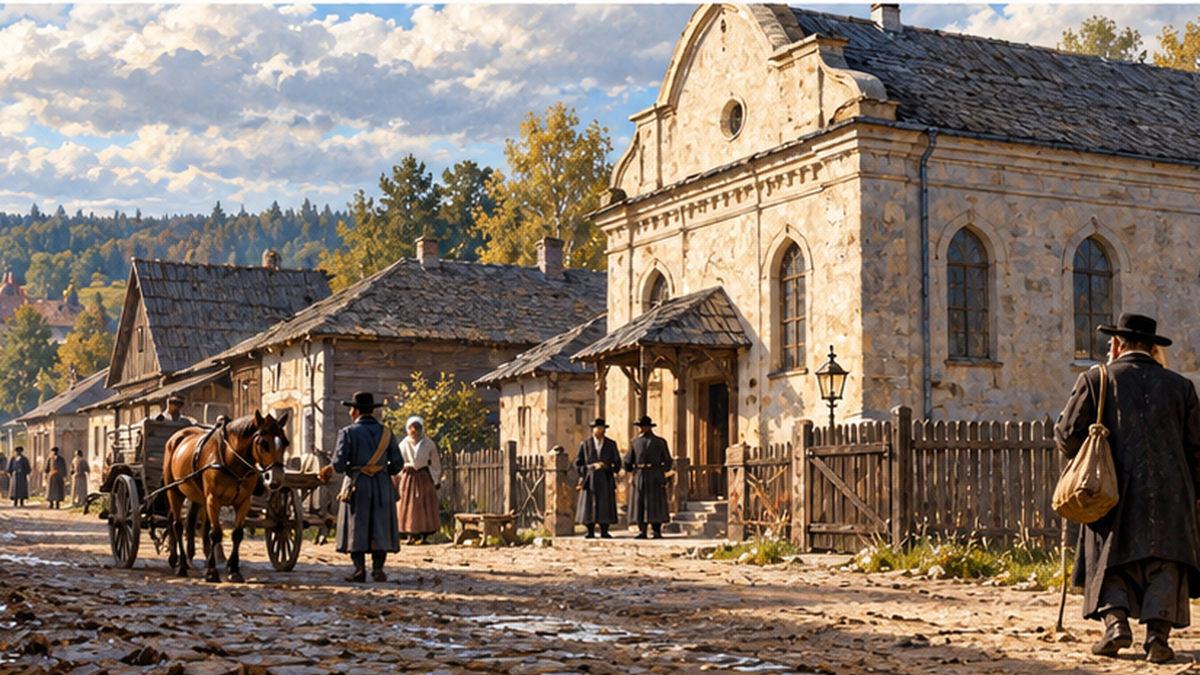
Przysucha is situated in central Poland, in an area that once had a substantial Jewish population. The old synagogue and Jewish cemetery remain important reference points for the town's Jewish heritage. The burial place associated with Simcha Bunim is visited by pilgrims. Wikimedia Commons hosts photographs of his grave and the former synagogue, while Polish cultural heritage institutions document local preservation efforts. The old synagogue itself should not be confused with the rebuilt or repaired structures around the cemetery. Much of the town's earlier Jewish community was destroyed during the Holocaust, making the surviving monuments part of a much larger story of loss and remembrance.
How to read Hasidic stories historically
Hagiographies preserve memories, moral examples and the emotional relationships between a teacher and disciples. They should not always be read in the same way as an archive containing dated administrative records. A reported dialogue may convey an ethical ideal even if the words were put into literary form generations later. The YIVO Encyclopedia provides a useful scholarly overview of the Pshiskhe dynasty, and general encyclopedic sources offer names and chronological orientation. Readers can compare those descriptions with Hasidic texts, paying attention to authorship and publication date. This distinction between tradition and critical history does not diminish religious memory; it helps explain what kind of evidence a source supplies.
An influence still discussed today
Simcha Bunim's legacy remains significant because the questions he raised are not limited to a particular century. What makes religious action sincere? How should a person respond to group pressure? Can a teacher encourage independent judgment while preserving loyalty to Jewish law and tradition? The Peshischa ideal of truthfulness influenced later Jewish debates about education, leadership and ethical character. Its legacy is visible in the histories of Kotzk, Ger and other Hasidic communities, but it also offers a window into the intellectual diversity of Polish Judaism. That influence is best understood through careful reading, local historical evidence and recognition of the differences among modern descendants of the movement.
Sources and further reading
- YIVO — Pshiskhe Hasidic Dynasty(https://encyclopedia.yivo.org/article.aspx/Pshiskhe_Hasidic_Dynasty)
- Wikipedia — Simcha Bunim of Peshischa(https://en.wikipedia.org/wiki/Simcha_Bunim_of_Peshischa)
- Wikimedia Commons — historical materials(https://commons.wikimedia.org/wiki/Category:Simcha_Bunim_of_Peshischa)
- Wikimedia Commons — Przysucha synagogue(https://commons.wikimedia.org/wiki/File:Synagoga_przysucha.jpg)
- Wikimedia Commons — the grave(https://commons.wikimedia.org/wiki/File:%D7%A4%D7%A9%D7%99%D7%A1%D7%97%D7%90_(1).jpg)
- Ger today — background(https://en.wikipedia.org/wiki/Ger_(Hasidic_dynasty))
Original source photographs and image licences
- Historic depiction of Simcha Bunim — public domain(https://commons.wikimedia.org/wiki/File:%D7%A9%D7%9E%D7%97%D7%94_%D7%91%D7%95%D7%A0%D7%99%D7%9D_%D7%9E%D7%A4%D7%A9%D7%99%D7%A1%D7%97%D7%94.jpg)
- Former synagogue, Przysucha — Jacques Lahitte, CC BY 3.0(https://commons.wikimedia.org/wiki/File:Synagoga_przysucha.jpg)
- Photograph of the grave and Polish cemetery(https://commons.wikimedia.org/wiki/File:%D7%A4%D7%A9%D7%99%D7%A1%D7%97%D7%90_(1).jpg)