
29 October 2026
B’nai Jeshurun in New York: two centuries of Jewish community
The congregation that began in 1825
B’nai Jeshurun is one of New York’s longest-established Jewish congregations. It was created in 1825 by thirty-two founders, most of them Ashkenazi members of the older Spanish and Portuguese congregation Shearith Israel. They wanted to preserve Jewish observance while following the German and Polish prayer rite, known as minhag Ashkenaz. Their plan combined tradition with an unusual measure of participation. The founders spoke about religious instruction, less formal services and the absence of status distinctions among members. The congregation began in temporary quarters on Pearl Street when New York was a much smaller port city and when the Jewish population of the United States was still modest. The decision to establish a second congregation in the city helped mark the development of a more diverse Jewish public sphere.
Moving through a changing Manhattan
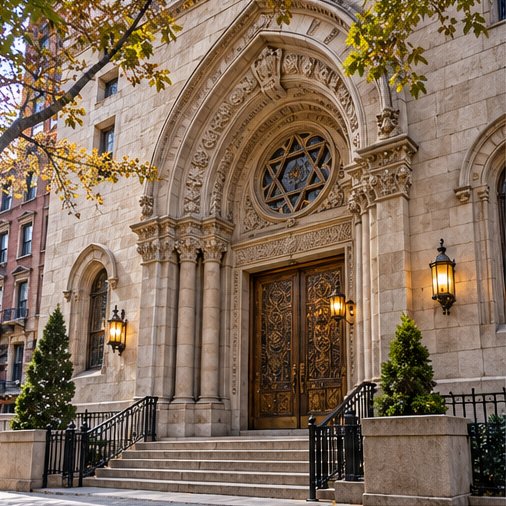
The physical history of B’nai Jeshurun closely follows the movement of Jewish residents north through Manhattan. After the early meetings on Pearl Street, the community moved to Elm Street, Greene Street, West 34th Street and Madison Avenue. Its prominent Madison Avenue synagogue, dedicated in 1885, reflected the confidence of an expanding congregation. In 1918 it moved to its present synagogue at 257 West 88th Street on the Upper West Side, between Broadway and West End Avenue. These moves were about more than real estate. Each neighbourhood represented a different stage in the city's development, the changing economic circumstances of congregants and the search for worship spaces that could accommodate both prayer and community institutions.
The Upper West Side building
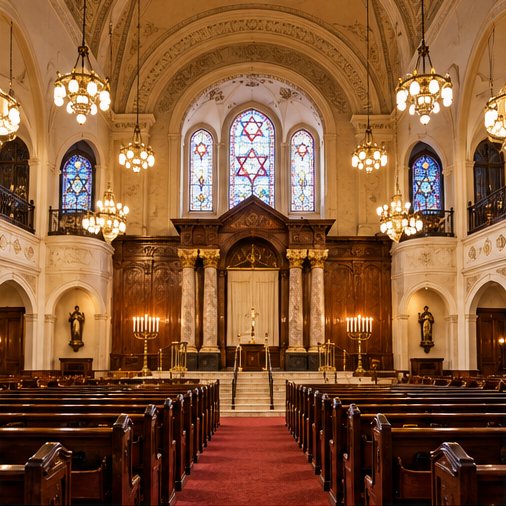
The West 88th Street synagogue is a major part of the congregation’s historical identity. Architects Henry B. Herts and Walter S. Schneider developed a building associated with eclectic early twentieth-century design, combining elements often described as Moorish and revivalist. Its distinctive sanctuary, decorated with arches and a striking ceiling, expresses the ambition to make a city synagogue both beautiful and useful. The building and adjacent community house are recorded in the United States National Register of Historic Places. Historical surveys document its changing interior and the role of organs in services at particular periods. The sanctuary has undergone important repairs and restorations. Visitors should not assume that every historical photograph reflects the layout or appearance of the building today.
Rabbi Israel Goldstein and the twentieth century
A major chapter began with Rabbi Israel Goldstein, whose long leadership helped the congregation address the challenges of modern Jewish life. Under his influence, B’nai Jeshurun developed a strong educational and civic mission while retaining prayer, Hebrew learning and community obligations. In the 1930s and 1940s Goldstein publicly called attention to the persecution of European Jews and advocated assistance to refugees. His work connected the synagogue to broader national and international organisations. The congregation became associated for a time with Conservative Judaism. That history matters because it shows that Jewish communities in America have not always fitted into permanent denominational categories. Their institutions have evolved through debate about religious law, ethics, identity and participation.
Renewal, music and communal prayer
In the late twentieth century, the congregation became especially well known for creative musical worship and an energetic Friday evening prayer culture. Rabbi Marshall Meyer inspired a period of spiritual renewal; subsequent leaders built on that foundation. Music, melody, singing and participation became central elements of its public identity. Rather than treating worship as a performance by a professional cantor, the congregation encouraged people in the room to take part. At the same time it continued to hold study sessions, festivals, memorial gatherings and opportunities for social action. A visitor may therefore encounter very different programmes on different days: traditional Hebrew liturgy, communal learning, contemporary interpretations of Jewish texts or activities addressing the needs of the neighbourhood.
An independent Jewish community
B’nai Jeshurun eventually chose an independent, non-denominational identity rather than remaining formally affiliated with the Conservative movement. Independence does not mean a lack of tradition or a single uniform level of observance. People who attend can have different backgrounds and understandings of Jewish law, and the congregation itself has developed its own ways of balancing inherited practice with openness. Its public materials emphasise inclusion, spirituality and responsibility. The Upper West Side is home to many Jewish institutions, but B’nai Jeshurun has a distinctive reputation for combining prayer and music with community organising, adult education and dialogue. It remains important to distinguish the congregation’s own self-description from generalisations about all Jewish life in New York.
Women in leadership and a bicentennial
In 2001 Rabbi Felicia Sol became the congregation's first woman rabbi, a significant development in a community whose institutional history began in 1825. In 2021 she became a senior rabbi. The congregation celebrated its bicentennial in 2025 with programmes dedicated to its past and to the music that helped shape its modern identity. Its history page records another transition in 2026: after more than four decades of leadership, Rabbi Rolando Matalon became Rabbi Emeritus, while Rabbi Sol assumed the role of Rosh Kehillah and Rabbi Alex Braver joined the spiritual leadership team. Other rabbis and Cantor Ari Priven are also part of its contemporary story. These details illustrate how a long-standing institution can preserve continuity while changing the people who lead it.
Education, public life and mutual responsibility
The institution’s importance cannot be measured simply by architectural age. Jewish education has long connected generations through Hebrew, scripture, holidays, music and ethical debate. Community organisations also help members respond to illness, bereavement, loneliness, food insecurity and other challenges. In New York, congregations routinely collaborate with schools, charities and social-service organisations. B’nai Jeshurun’s history repeatedly combines the religious and civic dimensions of this work. Members may disagree about political issues while still regarding the synagogue as a place where difficult questions can be discussed respectfully. That is one of the reasons its two-century history offers a useful perspective on migration, pluralism and democratic association in the United States.
B’nai Jeshurun and American Jewish history
From the first Ashkenazi prayer groups in a predominantly Sephardi Jewish city to today’s large, diverse Upper West Side congregation, the B’nai Jeshurun story reveals changes in immigration and identity. It also reflects the impact of antisemitism abroad, the development of Jewish charity and the growth of civic participation at home. Different generations approached language, prayer customs, gender roles and public responsibilities differently. A synagogue’s historical archive is therefore more than a record of rabbis and buildings. It can contain the names of volunteers, the patterns of neighbourhood life and evidence of how families sustained religious traditions across very different social environments.
Visiting responsibly and checking sources
Anyone interested in visiting should consult the congregation's official website for current services, entry arrangements and possible security requirements; these conditions may change. The historic building is located at 257 West 88th Street, Manhattan. The congregation’s own historical account, the United States National Park Service and specialist research on New York synagogue buildings provide complementary information. Wikimedia Commons includes photographs of the building, but licences and image credits must be checked individually. This article is a historical introduction, not a promise that all programme times or visitor conditions remain the same. The congregation's continuity into its third century remains a living story shaped by its members.
Sources and further reading
- B’nai Jeshurun — history(https://bj.org/history/)
- B’nai Jeshurun — current information(https://bj.org/)
- NYC AGO — building and organ history(https://www.nycago.org/Organs/NYC/html/BnaiJeshurun.html)
- Wikimedia Commons — B’nai Jeshurun(https://commons.wikimedia.org/wiki/Category:B%27nai_Jeshurun_(Manhattan,_New_York))
- National Park Service — historic building(https://npgallery.nps.gov/AssetDetail/92965b6a-868a-4b09-a411-0d3419182d04/)