
Antifa in the Jewish diaspora: opposing neo-Nazism while debating Zionism
28 October 2026
For Jewish communities in the diaspora, opposing neo-Nazism is not simply an abstract ideological preference. Synagogues, schools and community organizations face real security concerns. Yet a dispute has emerged because some activist groups also campaign against Zionism, the movement associated with Jewish national self-determination. The word “Antifa” does not identify a single organization with unified membership and policies. It covers various local networks and informal initiatives whose positions on Israel differ sharply. An accurate account must therefore distinguish opposition to Nazism, criticism of governments, ideological anti-Zionism and hostility toward Jews as Jews.
A movement without a central headquarters
Antifa is a broad label used by self-organized anti-fascist groups, neighborhood alliances, political activists and participants in demonstrations against the far right. Some organize counter-protests when neo-Nazis march; others provide information about extremist networks or advocate broader social change. They do not have one public spokesperson who can bind everyone who uses the label. A protester wearing black or holding a red-and-black flag cannot reliably be assigned to a particular organization by appearance. Similarly, a photograph taken at a street demonstration does not reveal the beliefs or associations of every visible individual. Reporting on such events requires named organizations and verifiable public statements.
Why the Holocaust matters to this debate
The Nazi genocide remains central to the political and cultural memory of Jewish life in Germany. Anti-fascism is meaningful when it confronts antisemitic conspiracy theories, violence against minorities and attempts to rehabilitate National Socialism. Anti-Nazi initiatives have helped mobilize public resistance to far-right marches. However, antisemitic ideas can also appear in organizations that describe themselves as progressive or anti-racist. The existence of such contradictions is not proof that all anti-fascists think alike. The useful question is whether specific speakers recognize Jewish history, condemn attacks on Jewish people and treat Jewish communities as equal participants in the public debate.
The divided left: anti-imperialist and anti-German traditions
Germany has a long-running intellectual conflict between political tendencies sometimes described as anti-imperialist and anti-German. The Federal Agency for Civic Education explains that anti-imperialist activists often interpret Israel and Palestine through global structures of power, colonialism and national liberation. Anti-German currents place greater emphasis on Germany’s Nazi history, antisemitism and Israel’s security. These are descriptions of tendencies, not fixed categories for every person on the left. Groups may agree that neo-Nazism must be opposed while strongly disagreeing on Hamas, the Israeli state, Palestinian rights and the meaning of solidarity. Jewish readers deserve to see those competing arguments accurately attributed.
Distinguishing criticism from antisemitism
Disagreement with an Israeli government, military operation or settlement policy is not, by itself, antisemitism. Such arguments are common in Israeli politics and journalism. Zionism, however, refers to a historical movement for Jewish national self-determination, and anti-Zionism contests that idea in different ways. A political argument becomes antisemitic when it collectively blames Jews for state actions, relies on traditional stereotypes, celebrates attacks on Jewish civilians or treats Jews elsewhere as agents of Israel. Researchers debate boundaries and terminology. Careful journalism can acknowledge that debate without erasing the difference between ordinary government criticism and hostility to a people.
Jewish self-determination and Palestinian rights
Modern Israel was established in 1948 after decades of political struggle, persecution and the catastrophe of the Shoah. For many Jews, the country provides an essential place of safety and collective self-determination. Other Jewish voices criticize particular versions of Zionism or advocate different political futures. Jewish identity is not reducible to a single platform. A serious discussion of anti-fascism must also recognize Palestinians as people with dignity, rights and legitimate fears. It is possible to condemn the Hamas attacks of 7 October 2023 and demands for the destruction of Israel while also documenting suffering among civilians in Gaza. None of those positions requires targeting Jewish neighbors.

Berlin protests do not represent one ideology
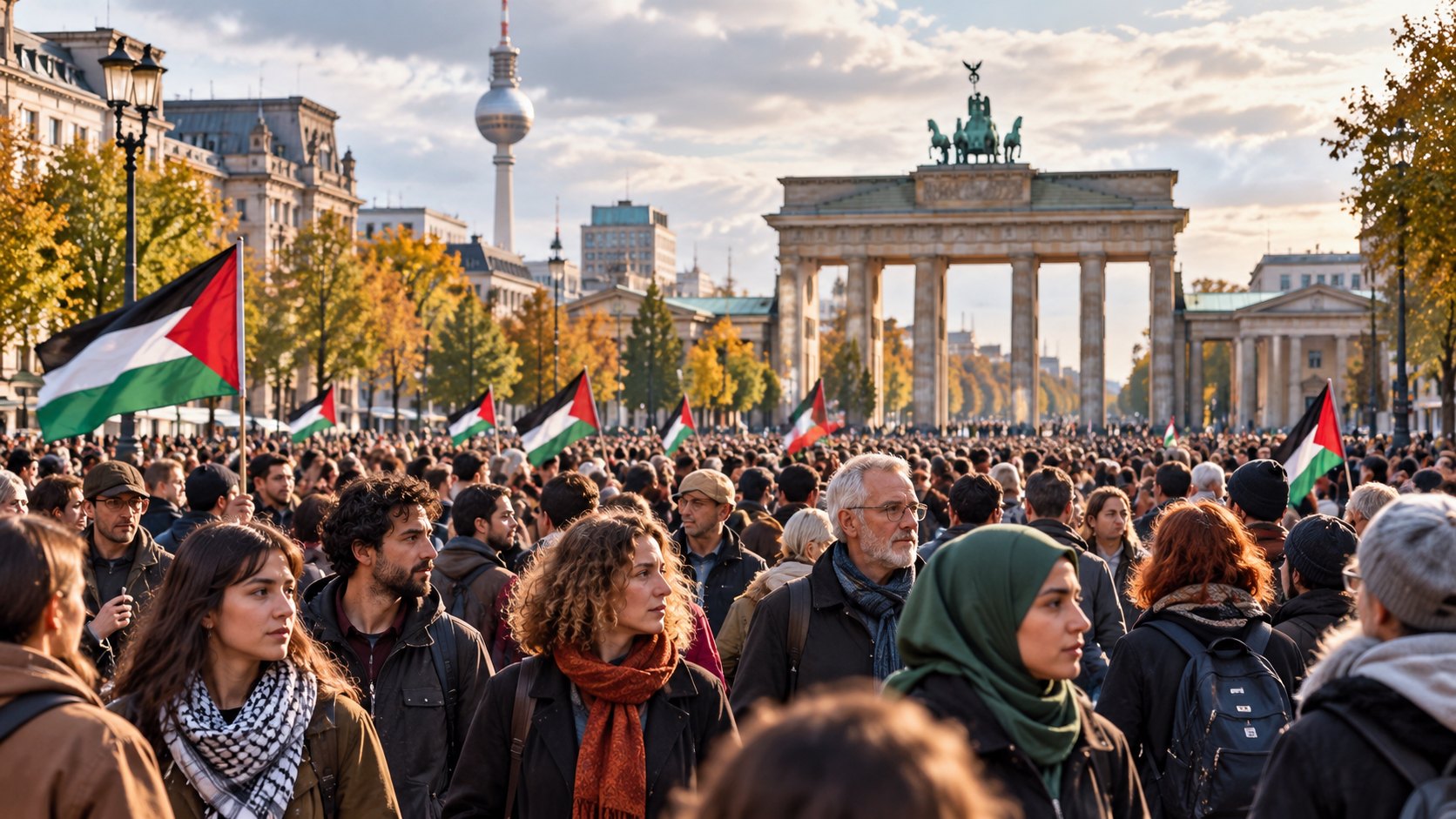
Berlin has hosted pro-Palestinian marches, vigils for the hostages, pro-Israel demonstrations, religious gatherings and peace initiatives. Attenders have included students, migrant associations, trade unionists, unaffiliated citizens and members of different activist networks. Calling all these events “Antifa demonstrations” would be misleading. Germany’s domestic intelligence report for 2024 describes the involvement of different extremist actors at some events, but explicitly states that most participants were not extremists and that most demonstrations took place without incident. The distinction between peaceful protest and documented criminal behavior is essential. Individual offenses require evidence tied to particular incidents rather than assumptions based on clothing, ethnicity or slogans.
What incident reports actually measure
RIAS Berlin records antisemitic incidents using criteria different from police crime statistics. Neukölln district reports that RIAS documented 118 incidents in 2023, 224 in 2024 and 158 in 2025 within the borough. These figures illuminate serious concerns about harassment, threats, abuse and safety, but they cannot measure the opinions of every resident or every protest participant. Police data and monitoring data are not interchangeable. An honest article describes the reporting system, reporting period and limitations before drawing conclusions. Jewish institutions may need security regardless of whether a hostile act led to criminal charges; equally, a recorded allegation is not automatically a final court finding.
The lived experience of Jewish communities
People who wear a kippah, speak Hebrew in public or accompany children to Jewish schools may experience an increasingly tense atmosphere directly. Some report avoiding certain streets or hiding Jewish symbols after threatening incidents. Others remain active in anti-racist and anti-fascist initiatives and consider both Jewish identity and democratic engagement inseparable. Communities include supporters of Israel, opponents of particular governments, religious people, secular families and people with conflicting opinions. Their differences should not be used to excuse threats. The key principle is straightforward: no Jew in Berlin, London or elsewhere should be judged responsible for the actions of an Israeli cabinet.
What photographs can and cannot establish
A photograph may show flags, police formations or a crowd. It cannot establish that an unknown person is a member of Antifa, an extremist or a participant in a specific violent episode. Labeling unidentified people as suspected activists based on appearance alone would be unfair and unreliable. The accompanying visuals here are clearly marked editorial illustrations, not photographs of the named events. Genuine documentary photographs should carry an author credit, date, location, license and an accurate statement of what was observed. Readers should be able to distinguish a real historical record from illustrative imagery. This protects both the subjects of reporting and the credibility of the publication.
A consistent democratic standard
An anti-fascist politics that opposes Nazi violence should also oppose antisemitism, anti-Muslim hatred and collective punishment. Democratic disagreement over the Middle East should never make Jewish children, synagogues or individuals into targets. For editors, a consistent standard means verifying slogans and incidents independently, quoting competing positions fairly, linking institutional research and avoiding sweeping claims about entire communities. A campaign’s language can be criticized, and a government can be challenged, without denying anyone their security or human dignity. That combination of rigor and care offers a more useful account than simply declaring one side wholly virtuous and another wholly threatening.
Documentation and further reading
- Federal Agency for Civic Education: anti-imperialist and anti-German currents (de/en)(https://www.bpb.de/themen/linksextremismus/dossier-linksextremismus/33626/antiimperialistische-und-antideutsche-stroemungen-im-deutschen-linksextremismus/)
- Federal Agency for Civic Education: antisemitism and anti-Zionism (de/en)(https://www.bpb.de/themen/antisemitismus/dossier-antisemitismus/was-heisst-antisemitismus/307746/antizionistischer-und-israelfeindlicher-antisemitismus/)
- Federal Office for the Protection of the Constitution: 2024 report (de/en)(https://verfassungsschutz.de/SharedDocs/publikationen/EN/reports-on-the-protection-of-the-constitution/2025-06-brief-summary-2024-report-on-the-protection-of-the-constitution.pdf?__blob=publicationFile&v=5)
- RIAS Berlin: documentation and reports (de/en)(https://report-antisemitism.de/press/)
- Neukölln district: Antisemitism commissioner (de/en)(https://www.berlin.de/ba-neukoelln/politik-und-verwaltung/beauftragte/antisemitismus/)
- Wikipedia (English)(https://en.wikipedia.org/wiki/Antifa_(Germany))
Related articles on israel.re - Israel Community Network
Gaza War 2023 2026(https://israel.re/en/gaza-war-2023-2026.html) · Jews New York(https://israel.re/en/jews-new-york.html)
בר · Wikimedia Commons · CC BY-SA 3.0 · resized