
Berlin and the Gaza-war protests: Neukölln, antisemitism and the right to assemble
28 October 2026
Since the Hamas attacks on Israel on 7 October 2023 and the ensuing war in Gaza, Berlin has witnessed repeated demonstrations, counter-rallies and vigils. Neukölln and Kreuzberg have frequently attracted particular attention. Participants have called for a ceasefire, the protection of Palestinians, the release of Israeli hostages and measures against antisemitism. Some rallies involved verified hateful incidents or police investigations; many others were peaceful. Understanding the city requires identifying the date, place and source of each reported event. The existence of a demonstration does not establish that everyone present supports the same ideology, slogan or violent act.
Why Neukölln is central to the story
Neukölln is a large and exceptionally diverse district in southern Berlin. Hermannplatz, Sonnenallee, Karl-Marx-Straße and the square outside the town hall have become recognizable public gathering places. After October 2023, demonstrations there were photographed and repeatedly covered, often producing images of flags, loudspeakers and police barriers. The visibility of a protest does not mean that most residents are involved, or that a neighborhood is uniformly hostile to Jews. The district’s antisemitism commissioner stresses that many local people actively oppose hatred and work for peaceful coexistence. Borough-wide judgments overlook those voices and risk creating a false portrait of daily life.
Three Gaza-related events on one specific day
A contemporary police statement provides a concrete example of multiple rallies. On Saturday 26 October 2024, Berlin police listed five assemblies held or announced in relation to regional conflicts. Three had explicitly pro-Palestinian or Gaza-related themes: one in Schöneberg concerning Gaza, Palestine and Lebanon; one in Fennpfuhl marking a year of ground operations in Gaza; and another in Schöneberg opposing Israel’s military conduct. A pro-Israel counter-rally and a demonstration concerning Rojava were also listed. These were not three identical marches through Neukölln, nor did the police report three equal-sized crowds. Exact geography and wording matter when a claim is repeated across languages.

Events at Neukölln town hall
The Berlin police also documented gatherings on Friday 25 October 2024 outside Neukölln town hall. One pro-Palestinian demonstration began with around ninety attendees, according to the police, before the crowd changed in size during the evening. Across the road or nearby, a pro-Israel counter-gathering demanded the release of hostages and expressed solidarity with Israeli victims. Police described particular slogans and confrontations and noted that some incidents were referred for possible criminal investigation. That establishes what the authorities recorded on the day, not the outcome of any later legal proceedings. It also does not justify attributing one speaker’s conduct to everyone nearby.
Earlier police reports from February and May
The same tensions can be traced to earlier documented events. On 14 February 2024, officers protected four assemblies linked to the regional conflict, including a relatively small gathering by Neukölln town hall that police initially described as trouble-free. On 11 May 2024, a march began at Oranienplatz with about five hundred participants before its size grew. Police reported an antisemitic statement broadcast over a vehicle loudspeaker, prompting intervention. Such records capture real incidents but also show that rallies varied considerably in scale and conduct. A responsible chronology must keep the distinction between peaceful participation, administrative restrictions, suspected offenses and proven crimes.
A warning against generalization in the official report
Germany’s 2024 domestic intelligence summary calls Berlin an important center of protest activity, with frequent events in Neukölln and Friedrichshain-Kreuzberg. It also says that most demonstrations proceeded without incident and that most participants were not extremists. The report notes that extremist actors from differing political backgrounds sometimes joined events. This combined finding is important precisely because it resists simple narratives. Security agencies must investigate threats and violence, but citizens also retain the constitutional right to assemble peacefully and criticize foreign or domestic policies. Neither right disappears because the conflict is emotionally charged or because a demonstration includes controversial political symbols.
Counting antisemitic incidents responsibly
Berlin’s antisemitism monitoring bodies and police collect different kinds of information. The district administration states that RIAS recorded 118 antisemitic incidents in Neukölln during 2023, 224 in 2024 and 158 in 2025. RIAS may document conduct that does not result in a criminal conviction, while police statistics follow legal categories. Numbers should always be given with their geographical boundary, timeframe and definitions. The records underline why Jewish schools, synagogues and individuals need protection and why public authorities must take threats seriously. They do not measure the personal opinions of all people living in Neukölln, nor the attitudes of all protesters.
Protest rights and the obligations of organizers
Germany’s Basic Law protects peaceful assembly. People can demonstrate for Palestinian rights, oppose arms exports, call for a ceasefire, support Israel, demand hostage releases or criticize the policies of a cabinet. Organizers must nevertheless respond to unlawful threats, incitement and banned symbols, and police may impose legally justified restrictions. Journalists should distinguish an event’s advertised title from a slogan actually heard at the site, and a police suspicion from a court ruling. They should also describe the actions of counter-demonstrators accurately rather than automatically treating every confrontation as coming from one side. These distinctions make legal and political reporting more reliable.
The experiences of Jewish Berliners
Jewish life in Berlin spans religious communities, schools, cultural institutions, migrants, long-established families and people with many different political opinions. Threats against a synagogue or abuse directed at a Hebrew-speaking passerby are antisemitic irrespective of the victim’s views about Israel’s government. Some Jewish Berliners take part in peace campaigns; others attend solidarity rallies for Israel or demand stronger security. They have an equal right to safety and public participation. Neukölln’s district office also points to civil society groups working against antisemitism and for mutual respect. A full account includes that constructive work alongside the disturbing incidents that required police attention.
The limits of images and slogans
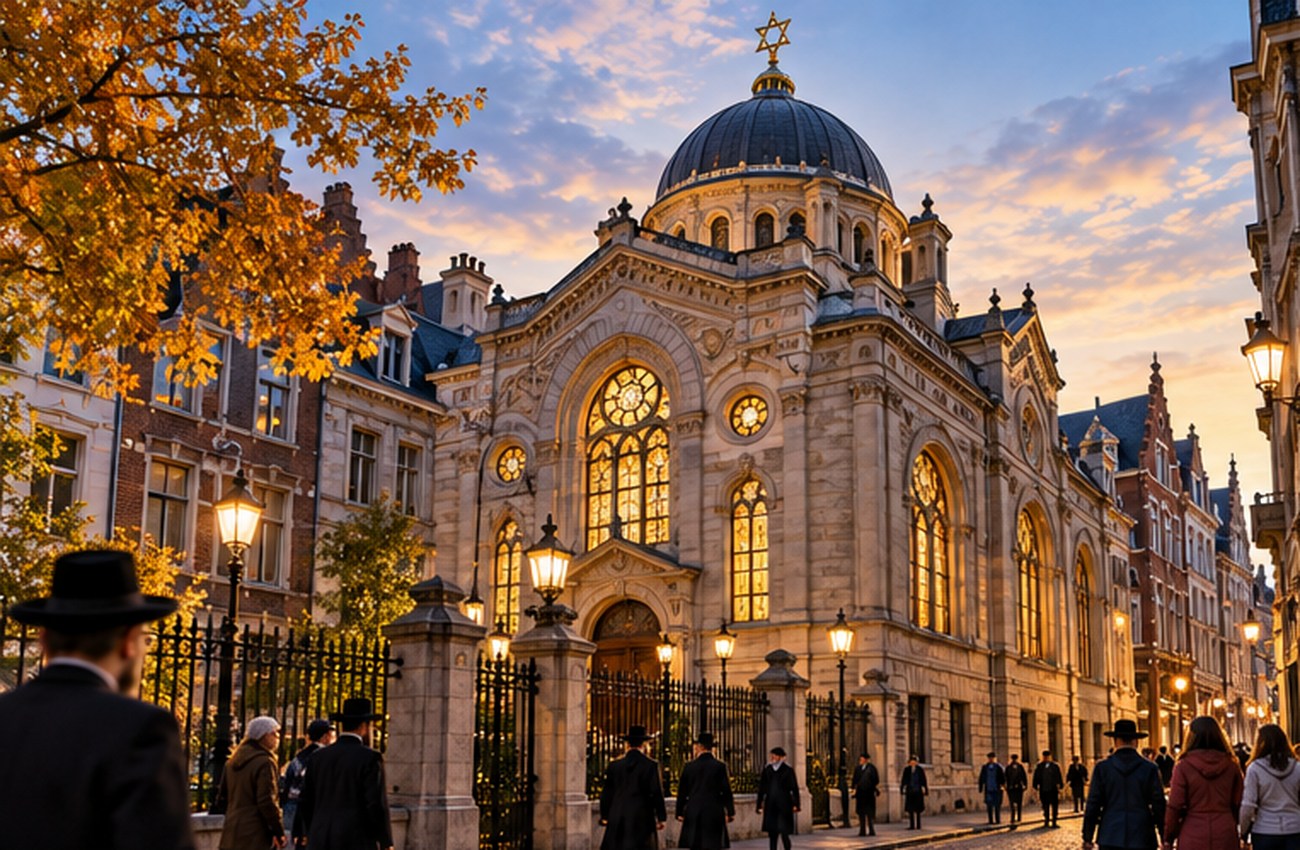
A scene of a mass rally can be visually striking, but it often fails to reveal who organized each part of a crowd or who shouted a specific phrase. No person should be labeled an extremist, anti-fascist activist or antisemitic offender merely because they appear in a photograph. The visuals presented with this article are editorial illustrations, not photographs of the precisely dated events discussed. Genuine event images need a verified capture date, photographer, location and reuse license. Such standards prevent mistakes as images are circulated from one language edition to another. They also ensure that visual storytelling does not outrun the evidence available in official records.
What a balanced account should achieve
Reliable reporting recognizes multiple legitimate experiences: Palestinians who are frightened for relatives in Gaza, Israelis and Jews who mourn victims of the Hamas attacks, families of hostages, and residents concerned about safety in Berlin. It also condemns verified antisemitic threats without accusing whole national or religious communities. The strongest sources for the particular Berlin episodes are police statements from February, May and October 2024, local administrative reports and specialist monitoring organizations. A reader should be able to check a date, distinguish a documented action from a political judgment, and reach an independent conclusion. Accuracy is especially important when the same article appears in seven languages.
Documentation and further reading
- Berlin Police: report on demonstrations on 26 October 2024 (de/en)(https://www.berlin.de/polizei/polizeimeldungen/2024/pressemitteilung.1497810.php)
- Berlin Police: four assemblies on 14 February 2024 (de/en)(https://www.berlin.de/polizei/polizeimeldungen/2024/pressemitteilung.1417214.php)
- Berlin Police: 11 May 2024 demonstration (de/en)(https://www.berlin.de/polizei/polizeimeldungen/2024/pressemitteilung.1445559.php)
- Neukölln district: figures and antisemitism protection (de/en)(https://www.berlin.de/ba-neukoelln/politik-und-verwaltung/beauftragte/antisemitismus/)
- RIAS Berlin: reports (de/en)(https://report-antisemitism.de/press/)
- Berlin public prosecution antisemitism reports (de/en)(https://www.berlin.de/generalstaatsanwaltschaft/antisemitismusbekaempfung/berichte/)
- Wikipedia (English)(https://en.wikipedia.org/wiki/Neuk%C3%B6lln)
Related articles on israel.re - Israel Community Network
Gaza War 2023 2026(https://israel.re/en/gaza-war-2023-2026.html) · Jews New York(https://israel.re/en/jews-new-york.html)
Lukas Beck · Wikimedia Commons · CC BY 4.0 · resized